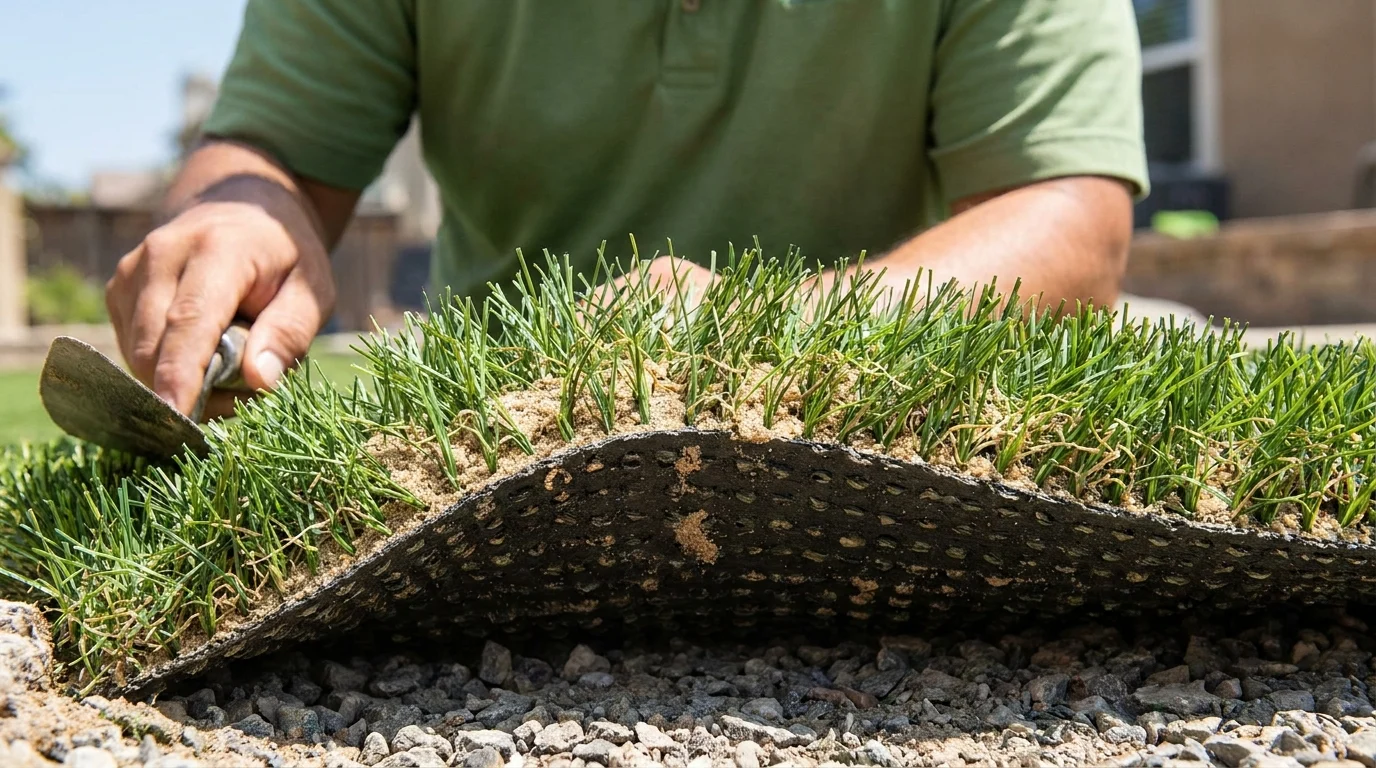
Artificial turf is made of synthetic polymer fibers tufted into a multi-layer backing, then filled with sand or other material to hold the blades upright. The fiber type, face weight, and backing quality are the three factors that most determine how long your turf lasts and how good it looks. Understanding what you’re actually buying saves you from choosing a product that falls apart in three years.
The fibers: what the blades are made of
The green blades you walk on are extruded plastic fibers. Manufacturers use three main polymers, and each one has a different job.
Polyethylene
Polyethylene is the most common fiber in residential turf today. It’s soft underfoot, handles UV exposure well, and holds its color for years. Most lawns, side yards, and pet turf installations in San Diego use polyethylene. If you’re replacing a grass lawn and want something that looks and feels natural, polyethylene is the right fiber.
Higher-density polyethylene resists matting better, which matters for high-traffic areas like play zones or dog runs.
Nylon
Nylon is the strongest synthetic fiber used in turf. It’s stiffer than polyethylene and can spring back to its original position even after heavy compression. That resilience makes it the standard choice for putting green installations, where ball roll consistency and surface firmness matter more than softness.
Nylon also handles heat differently. It doesn’t warp or deform in high temperatures the way cheaper fibers can, which is relevant in San Diego’s inland valleys where summer temperatures regularly push past 95°F. The trade-off is cost. Nylon turf runs higher per square foot, and it’s firmer to walk on, so it’s not usually the first choice for a family backyard.
Polypropylene
Polypropylene is the least expensive of the three. It’s commonly used for thatch layers, the brown or tan curled fibers mixed into the base to mimic dead grass and add visual depth.
It’s not a good choice for San Diego’s outdoor climate. Polypropylene has lower UV resistance than polyethylene and breaks down faster under direct sun. Reputable products use polypropylene only as a thatch component, not as the primary face fiber. If the primary blade fiber is polypropylene, that’s a budget-tier product.
The backing: what holds everything together
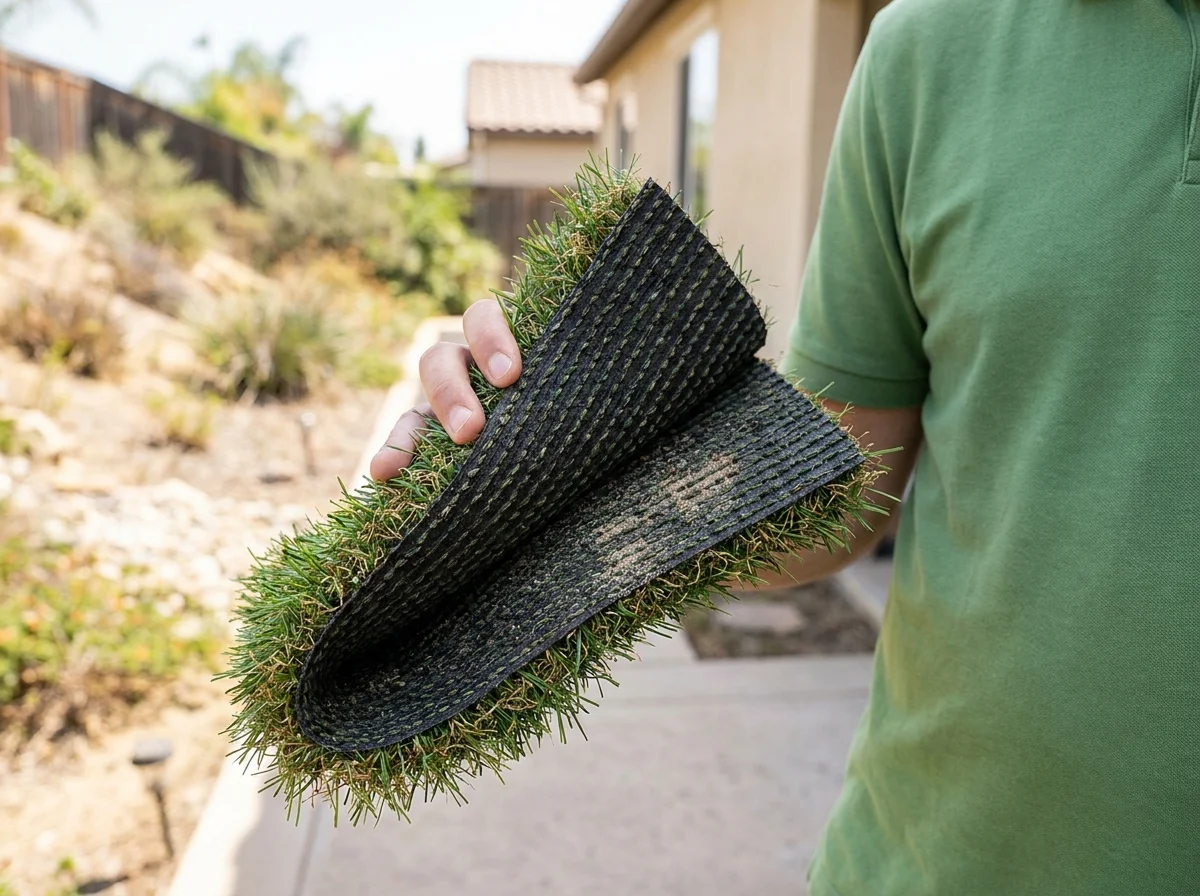
The backing is the foundation of any turf product. It’s what the fibers are anchored into, and it determines drainage performance, dimensional stability, and longevity.
Primary backing
The primary backing is the layer the fibers are tufted through. It’s typically a woven polypropylene fabric, sometimes with a secondary woven layer for added stability. The tufting process punches yarn loops through this fabric, much like how carpet is manufactured.
The density of the primary backing affects how securely fibers are held. Loose tufting shows up as fiber pullout over time, especially in pet areas where dogs dig.
Secondary backing and coating
After tufting, the back of the fabric is coated to lock the fibers in place. There are two main options: polyurethane and latex.
Polyurethane is the better performer. It’s flexible in cold temperatures, holds up longer, and doesn’t crack or peel over time. Most commercial and higher-end residential products use polyurethane.
Latex is less expensive. It works adequately in moderate climates, but it can harden and crack over years of exposure to temperature swings. For San Diego, where temperatures in Escondido or El Cajon can swing 40 degrees between summer afternoons and winter mornings, polyurethane backing lasts noticeably longer.
Drainage holes
Quality turf backing has perforated drainage holes spaced every few inches across the surface. These holes allow water to flow through at rates of 30 to 50 inches per hour in better products. For pet turf, drainage capacity is one of the most important specs you can ask about. Urine that sits in the system rather than draining through is the primary cause of odor problems. Adequate drainage, combined with the right infill, keeps pet areas fresh.
San Diego’s rainfall is concentrated into a short winter window, but coastal areas can see heavy downpours. Good drainage prevents standing water and keeps the base from washing out.
The infill: what goes between the blades
Infill serves several purposes. It weighs the fibers down so they stand upright, cushions the surface, moderates temperature, and in pet applications, manages bacteria and odor.
Silica sand
Standard silica sand is the most common infill. It’s inexpensive, heavy enough to stabilize fibers, and inert. Most lawn installations use silica sand as a base layer, often combined with a secondary infill material. Rounded grains drain better and don’t compact as aggressively as angular-cut sand.
Zeolite
Zeolite is a mineral-based infill with a porous structure that absorbs ammonia. It’s widely used in pet turf systems because it captures the primary compound in dog urine that causes odor. Zeolite isn’t permanent. It absorbs odor molecules until saturated, then needs rinsing or replacement. Properly maintained, it keeps a pet area smelling clean for years.
Coated and colored sand
Coated sand products are silica sand with a polymer or acrylic coating. The coating reduces dust, resists compaction, and in some formulations helps cool the surface slightly. These products are worth considering for areas that get direct afternoon sun, where turf surface temperatures can climb significantly above ambient air temperature. Our post on how hot artificial turf gets in San Diego goes deeper on that topic.
Face weight and pile height explained
These are the two specs you’ll see most often on product sheets.
Face weight is the weight of the fiber per square yard, measured in ounces. It tells you how much material is in the blades, not the backing. Lawn turf typically runs 50 to 75 ounces. Sports fields run higher, sometimes 80 to 90 ounces. Higher face weight generally means a denser, more realistic appearance. But face weight alone doesn’t tell the whole story. A product with low-quality fiber at 80 ounces can still underperform a quality fiber at 60 ounces.
Pile height is the length of the fiber blade measured from the backing surface. Lawn turf typically runs 1.25 to 2 inches. Longer pile looks more natural but requires more infill to keep blades upright. Shorter pile is easier to maintain and works well for high-traffic zones. Putting greens use much shorter pile, often under an inch, to keep the ball roll true.
For a full breakdown of pricing across product tiers, see our artificial turf cost guide for San Diego.
What separates quality turf from cheap turf
The differences come down to material choices compounded across every layer. Quality turf uses:
- Polyethylene face fibers with UV stabilizers rated for 15 or more years
- Polyurethane secondary backing, not latex
- Consistent drainage hole spacing with verified flow rates
- Thatch fibers included for natural appearance, not polypropylene primary blades
- Manufacturer warranties that actually cover the face fiber, not just the backing
Cheap turf saves money at every layer: polypropylene blades, latex backing, minimal drainage, thin tufting. It often looks fine in a showroom or on a small sample, but the problems show up at year three or four. The fiber color fades faster. Blades flatten under foot traffic. Backing cracks and drainage fails.
If you’re comparing products for an installation in San Diego County, ask for the face fiber spec, the backing type, and the drainage rate. Those three questions will separate the quality products from the ones that aren’t worth installing.
Our artificial turf installation guide covers what to expect during the full process, from base prep to final infill.
Common questions
Is artificial turf made from recycled materials?
Some products incorporate recycled content in the backing or infill. Recycled tire crumb rubber was commonly used as infill for years and is still available, though many homeowners prefer silica sand or zeolite for residential use. Face fibers in quality products are typically virgin polyethylene, since recycled plastic doesn’t offer the same UV stability or color consistency.
Does artificial turf contain lead or other toxins?
Older turf products, especially those installed before 2010, sometimes used lead chromate as a color stabilizer. Modern residential turf manufactured to current standards doesn’t use lead. If you’re replacing turf more than 15 years old, confirm the fiber spec before handling it. Products sold today for residential use don’t contain heavy metal stabilizers.
How long does artificial turf last?
Quality turf installed over a proper compacted base typically lasts 15 to 20 years in San Diego’s climate. The UV exposure here is significant, so the UV stabilization in the fiber polymer matters more than it would in a cloudy-climate market. We cover this in detail in our post on how long artificial turf lasts in San Diego.
What’s the difference between turf for lawns and turf for dogs?
Pet turf uses the same basic construction but is optimized for drainage and odor control, with more drainage perforations, a polyurethane backing, and zeolite or antimicrobial infill. Some products have a shorter pile height to make cleaning easier. Infill choices matter more than the fiber spec for long-term performance in a dog yard. See our turf infill types guide for a full comparison.
If you’d like to look at samples in person or get a quote for a specific project, reach out through our contact page or call us at (858) 925-5546. We serve San Diego County and we’re happy to walk through product specs with you before you commit to anything.