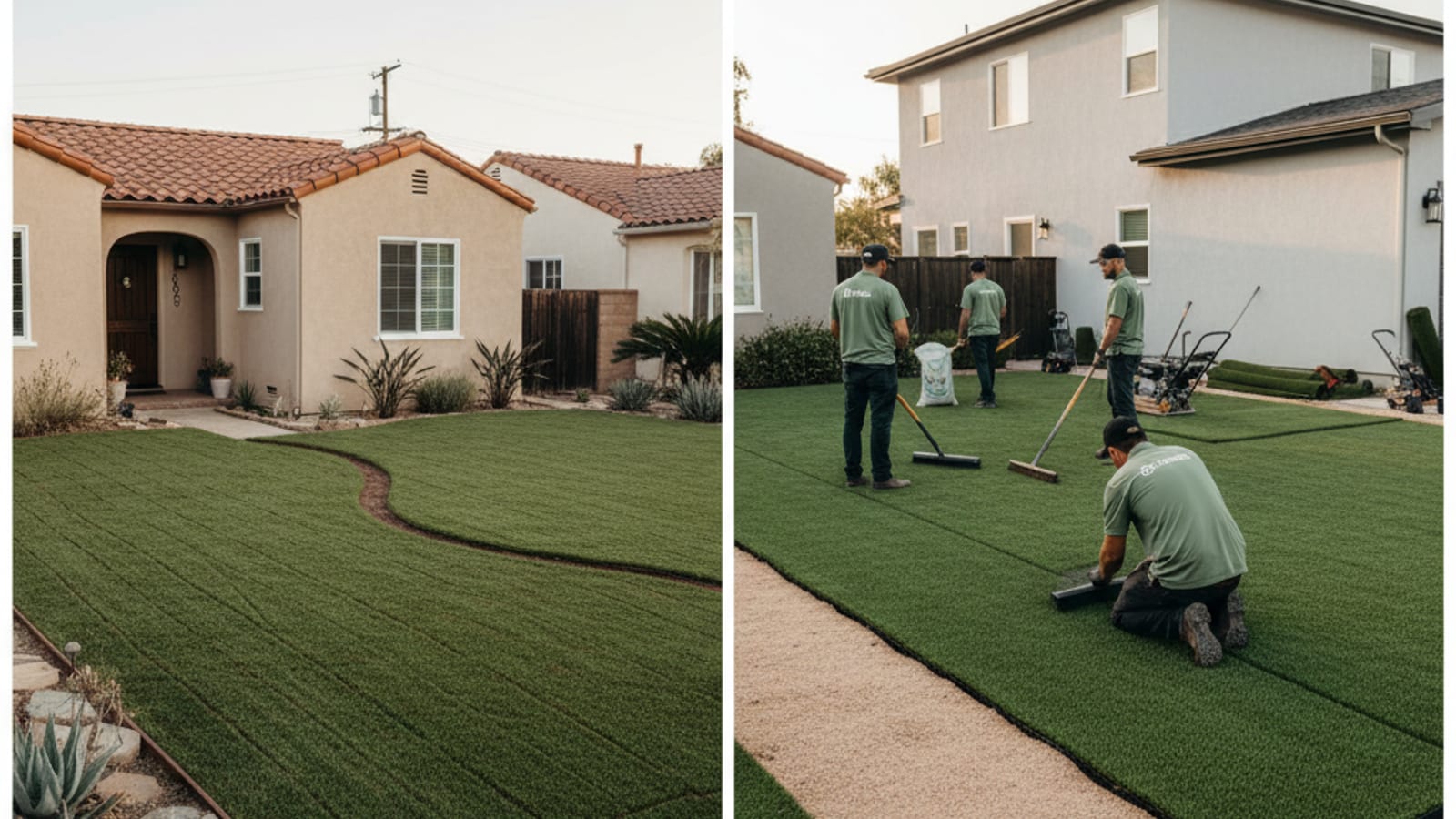
Premium artificial turf in San Diego lasts 15 to 20 years when installed correctly and maintained reasonably. We’ve pulled and replaced 18-year-old installs that still look better than the live grass on adjacent properties. We’ve also seen cheap big-box turf fail in 4 years.
The lifespan range is wide because four things move it dramatically up or down.
What sets the lifespan ceiling
Turf grade. Manufacturer warranties run from 8 years (entry-level) to 15 years (premium). Real-world life usually goes 5 years past the warranty if the install was done right. We default to 12-year warranty turf or better.
Two specs to look at on a turf data sheet:
- Face weight. Ounces of yarn per square yard. 60-90 oz is residential standard. 90+ is heavy-duty or commercial.
- Backing type. Polyurethane backing outlasts latex by years. Premium turf uses PU.
UV exposure zone. This is the single biggest variable in San Diego.
- Coastal yards (La Jolla, Encinitas, Coronado): marine layer cuts UV intensity. Turf often hits 18-20 years here.
- Central / urban yards: typical lifespan 15-18 years
- Inland and East County yards (Escondido, El Cajon, Santee): full sun pushes blade fade and brittleness. 12-15 years is more realistic
- Backcountry / desert (Borrego, Julian): aggressive UV plus freeze-thaw cycles. 10-13 years
Turf with explicit UV-stabilization in the manufacturing spec will outlast turf without it by 30%+ in inland zones.
What kills turf early
The main failure modes we see:
Bad base prep. Insufficient base depth, missing compaction, no drainage planning. Turf sitting on a poor base shows divots, seam separation, and standing water within 2-3 years. The turf might still look okay; the install fails.
Sun + cheap turf. Big-box turf in inland sun goes from green to gray-green in 4 years and brittle by year 6. Premium UV-stable turf in the same sun lasts 12+.
Pet damage on non-pet-rated installs. Standard residential turf in a heavy-pet yard lasts 5-7 years instead of 15. Pet-rated turf with proper drainage and zeolite infill restores the lifespan.
Burn damage. BBQ embers, fire pit sparks, fireworks, dropped cigarettes. Polyethylene melts at ~250°F. One incident can take a 5x5 ft section out. Patches are doable; prevention is better.
Heavy traffic without infill maintenance. Walking lanes flatten blades over time. Unmaintained yards in high-traffic spots look matted by year 8. Power-brushing every 2-3 years restores blade stand-up.
What extends turf life
Annual hose-rinse. Removes accumulated dust and pollen, refreshes blade flexibility. Takes 15 minutes once a year.
Quarterly enzyme treatment for pet yards. Prevents ammonia buildup that degrades infill and backing.
Power-brushing every 2-3 years. Lifts blades back to install-day stand-up. The crews we send do this as a service, or you can rent a unit and DIY.
Infill top-up around year 5-8. Infill migrates and settles. Topping up restores blade support and shock absorption.
Shade where possible. Natural shade or shade structures in inland yards meaningfully extend lifespan.
When does it actually need replacement?
The functional end-of-life signs:
- Faded color you can’t restore with brushing. Turf has lost UV stabilizers in the polymer. No fix.
- Backing is brittle and seams split easily. Polyurethane has degraded. Reseam might hold for 6 months, then split again.
- Drainage is failing. Water sits on the surface after rain. Usually means the base has settled or the turf backing has lost permeability.
- Blade fibers are crumbling at the tips. End-of-life polymer breakdown.
If you’re seeing one of these, you’re at end-of-life. If you’re seeing multiple, replace before the next summer.
What about the base?
Here’s the good news: the base lasts essentially forever. When the turf needs replacement, the base typically still works. A turf-only swap is much cheaper than a full reinstall, usually 60% of original install cost.
Turf-only replacements are routine on 18-year-old installs where the original base is still within spec.
Comparison: live grass over the same window
15 years of live grass in a San Diego front yard typically means 2-3 full reseed cycles, ongoing irrigation system replacements, fertilizer programs, and the occasional dead-spot remediation. The total dollar spend usually exceeds 2x what 15 years of artificial turf costs (install plus maintenance).
If you’re picking between a 15-year horizon of live grass vs artificial turf, the cost math favors turf in San Diego conditions.
Free assessment
If you’ve got an existing turf install you want assessed for remaining life, or you’re considering a new install, we offer a free in-home assessment any day of the week.
Related guides
- Turf infill types explained
- Pet turf vs standard turf
- Service: turf cleaning & maintenance
- Service: turf repair & reseaming
- DIY: pet turf cleaning
Call (858) 925-5546 or use the contact form.