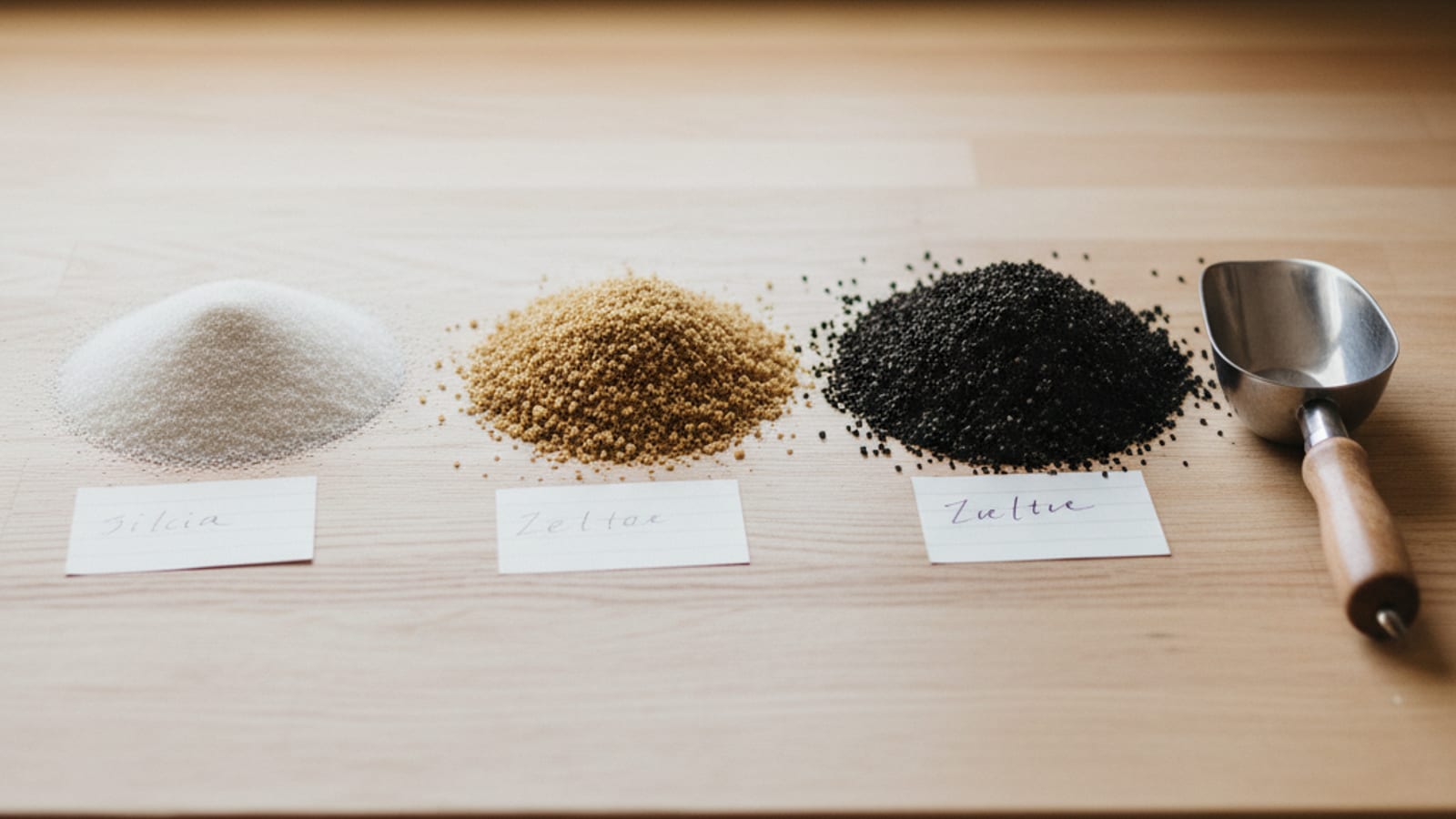
Infill is the part of an artificial turf install most homeowners ignore, and the part that decides how the yard feels, drains, and ages. Get infill wrong and a $9,000 install starts looking flat and matted by year three. Get it right and the yard holds up for 15+ years.
Three infill types cover 95% of San Diego turf installs. Each has a specific use case.
What infill actually does
Infill is granular material brushed between turf blades down to the backing. It does four things:
- Weights the turf so it stays flat against the base
- Holds blades upright by surrounding the base of each blade
- Provides drainage by spacing blades apart at the bottom
- Cushions impact under foot traffic
Without infill, turf blades flatten quickly, drainage suffers, and the surface feels hard and slippery. Most quality installs use 1.5-3 lbs of infill per square foot, brushed in over multiple passes.
Silica sand
The default. Crushed quartz, sized between 16 and 30 grit. White or off-white. Cheapest infill option.
Use cases:
- Standard residential lawns
- Backyard turf without pets
- Putting greens (fine-grade silica only)
- Sport practice surfaces
Strengths:
- Cheapest material cost
- UV-stable indefinitely
- Easy to work with, readily available
- Good drainage flow
Weaknesses:
- Doesn’t bind ammonia (bad for pet yards)
- Can compact over years, requiring top-up
- Slightly abrasive (rare issue, but worth noting for kid-heavy yards)
Cost: $0.40-$0.60 per sq ft installed.
Zeolite
Naturally occurring volcanic mineral with a porous crystalline structure. Gold to honey-colored granules. Higher cost than silica.
Use cases:
- Pet turf (the main reason zeolite exists in turf installs)
- Daycare and playground turf
- Yards where odor control matters
Strengths:
- High cation-exchange capacity that chemically binds ammonia from urine
- Same mineral used in cat litter, for the same reason
- Reduces odor without chemical additives
- Lasts 10+ years before saturation
Weaknesses:
- Higher material cost
- Needs eventual refresh in heavy-pet yards (5-7 years)
- Slightly heavier than silica (negligible practical impact)
Cost: $1.20-$1.80 per sq ft installed. Adds ~$1 per sq ft to a pet turf install vs. silica.
Crumb rubber
Recycled rubber granules, typically from recycled tires. Black. Mostly used in sport applications.
Use cases:
- Sport turf (soccer, baseball cleat areas)
- Backyard batting cages and practice areas
- Playground turf with shock-absorption requirements
Strengths:
- Excellent shock absorption (G-max ratings reduce injury risk)
- Provides cleat traction in sports applications
- Most durable infill type, doesn’t compact
- Long lifespan
Weaknesses:
- Heat retention. Black rubber runs hot in sun (worst of the three for surface temps).
- Aesthetic. Visible black granules in turf for some installations.
- Cost. Comparable to or higher than zeolite.
- Some homeowners avoid recycled rubber for environmental reasons
Cost: $1.40-$2.00 per sq ft installed.
Sand-and-rubber blends
Common in sport turf. Sand provides blade support; rubber adds cushioning. Typically 70/30 sand/rubber by weight.
Use cases: Backyard sport surfaces, batting cages, multi-use yards.
Coated sand alternatives
A few specialty products coat silica sand with antimicrobial or color-stabilizing compounds. Marketing claims vary widely. We’ve found most don’t outperform plain silica or zeolite enough to justify the cost premium. We’ll consider them on a case-by-case basis but don’t default to them.
How much infill goes into a yard?
A typical residential install uses 1.5-3 lbs of infill per square foot. For a 500 sq ft yard, that’s 750-1,500 lbs of infill. The crews we send brush in multiple passes against the grain to work it down to the backing.
Putting greens use less infill (lighter weight) for faster surface speed. Pet yards use more (full weight) for blade support under traffic.
When does infill need refresh?
Standard residential yards: Top-up around year 5-8 as infill settles or migrates. Costs $400-$700 typically.
Pet yards (zeolite): Full refresh around year 5-7 if odor returns despite enzyme treatment. Vacuum out old infill, brush in fresh. $600-$1,000.
Sport yards: Annual top-up in heavy-use spots (batter boxes, kick zones). DIY or professional, takes 30 minutes.
What if my yard already has the wrong infill?
The crews we send can swap infill on existing installs. Vacuum out the old, brush in the new. Most common swap: silica to zeolite for pet yards that started as standard installs. Typically $400-$800 for a 500 sq ft yard.
How we pick
For every install we ask three questions:
- Will pets use this yard regularly? If yes, zeolite.
- Is this a sport surface or putting green? If sport, sand-and-rubber blend. If putting, fine silica.
- Anything else? Standard silica.
We talk through the choice during the quote visit so the spec is dialed before install day.
Free quote
We’ll measure, talk through your use, and recommend the right infill spec.
Related guides
- Pet turf installation guide
- Pet turf odor control
- DIY: infill explained
- Service: turf cleaning & maintenance
- Service: sport & practice turf
Call (858) 925-5546 or use the contact form.