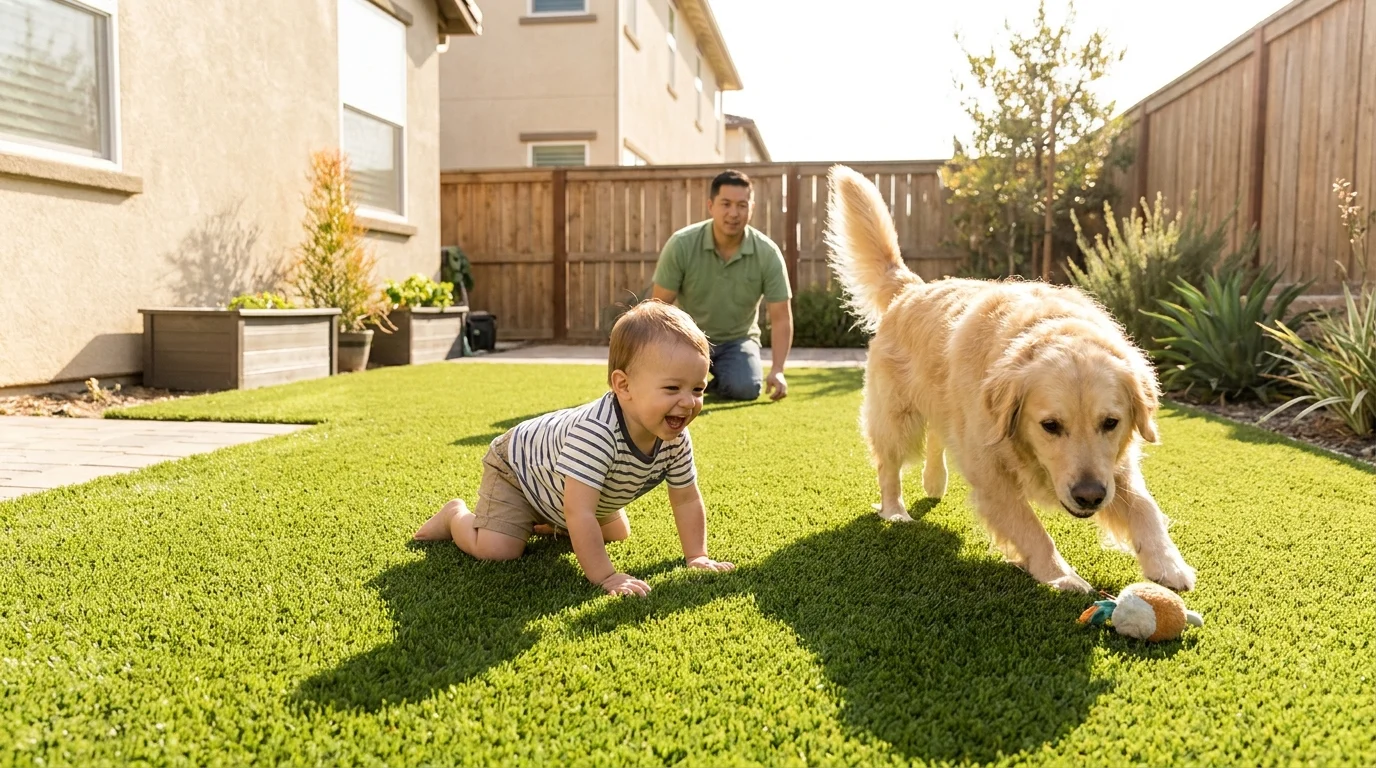
Modern residential artificial turf made after 2010 is not the same product that sparked health concerns in the early 2000s. The biggest risks came from lead-based pigments in old turf and crumb-rubber infill on sports fields, not from the polyethylene turf used in most residential yards today. That said, questions about PFAS and heat offgassing are still being researched, and it’s worth understanding what you’re buying before installation.
Here’s a calm, factual breakdown of what’s known, what’s uncertain, and how to pick a safer product for your San Diego home.
Old turf vs. modern Prop 65-compliant products
Early artificial turf, particularly products manufactured before 2008, often used lead chromate as a UV stabilizer to keep the grass blades looking green. Lead is toxic at any level, especially for young children who may touch the turf and put their hands in their mouths.
California’s Prop 65 program changed that picture significantly. Prop 65 requires businesses to warn consumers before knowingly exposing them to listed chemicals, including lead. Reputable turf manufacturers now formulate their products specifically to comply with Prop 65, which in practice means no detectable lead in the fiber or backing.
If you’re replacing old turf installed before 2010, have the original product tested before removal. Disturbing lead-containing material during tear-out creates dust. An experienced installer, like the team at Green Pro Turf San Diego, should follow proper removal protocols and can point you toward certified lead-free replacement products.
What to look for in a product certificate
Ask the manufacturer for a third-party test report showing lead content below the Prop 65 threshold (currently 0.5 micrograms per day maximum exposure). Reputable brands publish these readily. If a supplier can’t produce one, that’s a signal to keep looking.
Crumb rubber vs. sand and zeolite infill
This is the area where the most public health research has been done, and it’s worth separating field turf from residential turf.
Crumb rubber infill is made from recycled tires. It’s been used widely on school athletic fields and municipal sports facilities. Studies, including a large 2019 Federal Research Action Plan involving the EPA, CDC, and NIH, looked at whether soccer players had higher cancer rates linked to crumb rubber exposure. The findings were inconclusive, not alarming and not fully cleared. The research is ongoing.
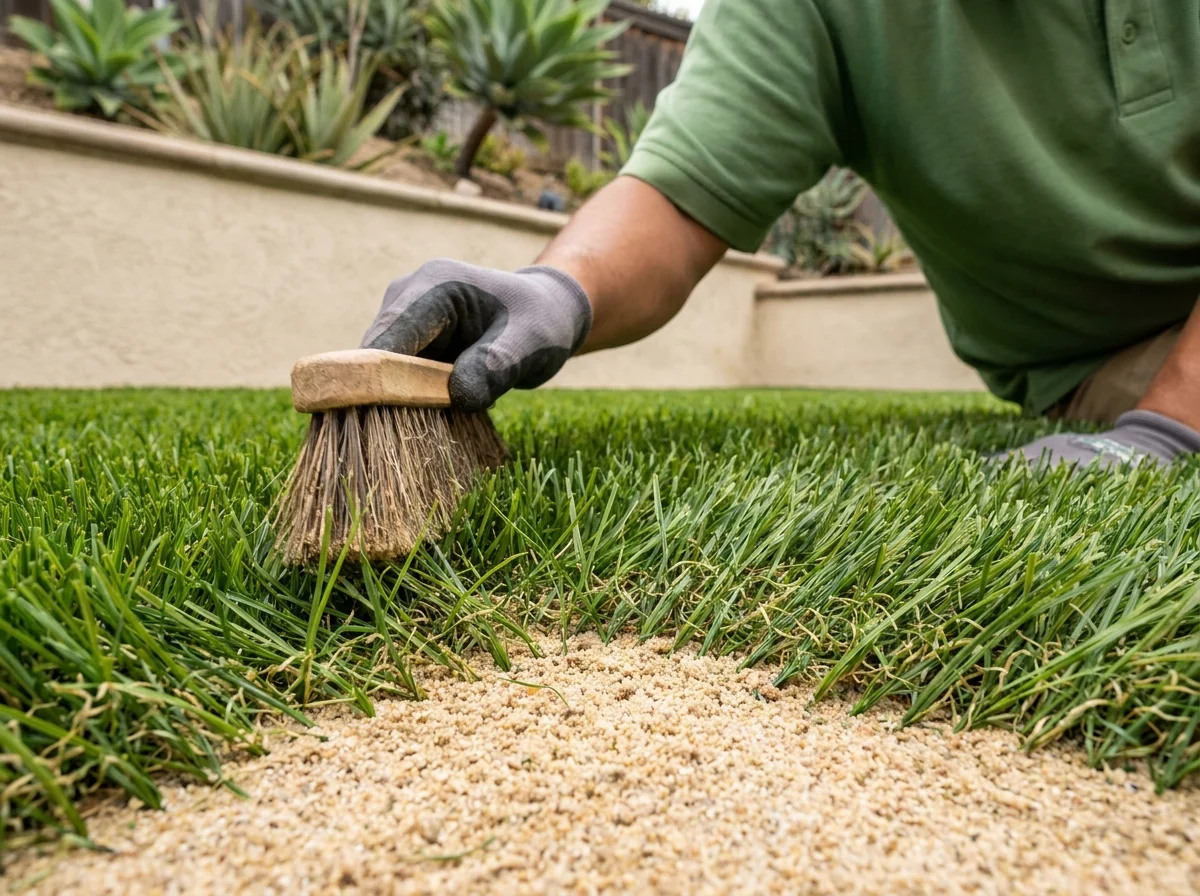
Here’s the important distinction for San Diego homeowners: most residential turf installations and virtually all playground turf and pet turf use crumb-free infill options, primarily silica sand, coated sand, or zeolite. Zeolite is a natural volcanic mineral with antimicrobial properties that works well for pet areas because it absorbs ammonia.
If you’re installing turf in a backyard, a school play area, or anywhere kids and pets spend time, specify sand or zeolite infill. The crumb rubber conversation largely applies to high-traffic sports fields, not the residential products most families are asking about.
We cover infill options in more detail in our guide to turf infill types explained.
PFAS and what’s known vs. unknown
PFAS, or per- and polyfluoroalkyl substances, are a class of synthetic chemicals used in many manufactured products for water resistance and durability. The question of whether artificial turf contains PFAS is newer and less settled than the lead or crumb rubber questions.
Some studies have detected PFAS compounds in turf fibers and backing materials. Others have found low or undetectable levels. The research is fragmented, and testing standards aren’t yet uniform across the industry.
What’s fair to say right now: there’s no established consensus that residential turf poses a significant PFAS exposure risk, but there’s also no blanket clearance. If PFAS is a concern for your family, the most practical step is to ask your installer specifically whether the product has been tested for PFAS and request documentation. Some manufacturers have proactively removed PFAS-containing coatings from their products in response to market demand. That’s a reasonable thing to verify before purchase.
California’s regulatory environment tends to move faster on chemical restrictions than most states, so this is an area where product standards are likely to tighten over the next few years.
Heat and offgassing
Artificial turf gets hot. On a sunny San Diego afternoon, a dark-bladed turf surface can reach 150 to 180 degrees Fahrenheit. That’s a separate safety consideration from toxicity, but it’s real and worth mentioning.
Offgassing, where synthetic materials release volatile organic compounds (VOCs) at high temperatures, is a legitimate question. Research on residential polyethylene turf has generally found low VOC emissions, even when surfaces are hot. The emissions profile of polyethylene is much cleaner than older nylon-based products.
Cooling measures like shade structures, infill selection (lighter-colored sand runs cooler than dark crumb rubber), and rinsing the turf with water before use on hot days are practical mitigations. For children’s play areas, the heat concern is more pressing than the offgassing concern based on current evidence.
Our full artificial turf installation guide covers cooling and drainage options suited to San Diego’s climate.
Is artificial turf safe for pets?
For most pets, yes, with the right product and infill. Polyethylene turf is non-toxic if chewed or licked in small amounts, and it won’t harbor fleas and ticks the way natural grass does.
The relevant considerations for pets are infill choice and drainage. Crumb rubber infill on a dog run creates a mess and can stick to paws and fur. Sand or zeolite infill is cleaner and safer. Zeolite in particular is commonly used in pet turf installations because it neutralizes odors and resists bacteria.
Drainage matters too. Poor drainage means standing water and odor buildup. A properly installed pet turf system with a perforated backing and crushed aggregate base drains quickly and stays cleaner. You can read more about the full setup in our pet turf installation guide for San Diego.
If your dog is a heavy chewer, supervision and the occasional deterrent spray are still a good idea. No surface is indestructible.
Is artificial turf safe for kids and playgrounds?
Playground turf is a different product category from landscape turf. It’s typically installed over a cushioned shock-absorbing pad to meet fall height safety ratings, and it uses finer pile heights appropriate for play areas.
The safety standards that matter for playgrounds are ASTM F1292 (impact attenuation) and ASTM F3351 (synthetic turf systems). Lead-free certification and crumb-free infill are both relevant and achievable with current products.
California has stricter standards for school and public playground surfaces than most states. When turf is specified for a school or public play area, it needs to meet both state and local requirements. The crews we send install playground turf systems in San Diego that are designed to meet those specs. More detail is in our guide to artificial turf for playgrounds.
How to choose safer turf
If you’re doing your due diligence before an installation, here’s a straightforward checklist:
- Ask for Prop 65 lead-free certification. This should come from a third-party lab, not just a manufacturer claim.
- Specify crumb-free infill. For residential, pet, and playground applications, use silica sand, coated sand, or zeolite. Skip crumb rubber entirely.
- Ask about PFAS testing. Not every manufacturer has done it yet, but it’s a reasonable question. Some have.
- Check the backing material. Polyurethane and latex backings are common. Both are generally low-VOC when cured. Ask for the product spec sheet.
- Choose a licensed installer. In California, turf installation falls under the C-27 license (landscaping). Licensing means the contractor carries insurance and is accountable to state contractor laws.
- Review the warranty. A reputable product comes with a manufacturer warranty, typically 8 to 15 years. Cheap products often don’t.
We’ve put together more background on what turf is actually made of in our post on what artificial turf is made of.
Common questions
Does artificial turf cause cancer?
No clear causal link has been established. The most-studied question is whether athletes on crumb-rubber fields have higher cancer rates. The 2019 federal study found the evidence insufficient to draw conclusions either way. Residential turf with sand or zeolite infill hasn’t been the subject of the same concern.
Can I install turf around a vegetable garden?
Yes, with standard precautions. Keep the turf border at least 12 inches from edible plants, use a lead-free certified product, and don’t use crumb rubber infill near food-producing areas. These are the same common-sense practices you’d use with any synthetic material near a garden.
Is older turf dangerous to remove?
It can be, if it was manufactured before 2008 and may contain lead. Have it tested first. If lead is present, removal should include dust control, personal protective equipment, and proper disposal. A licensed contractor can handle this correctly.
Does turf off-gas more when it’s new?
New products may have a faint odor for the first few weeks as residual manufacturing compounds dissipate. This fades quickly. Rinsing new turf a few times before heavy use helps speed that process. Long-term, polyethylene turf is considered low-emission by most current research.
If you’re weighing artificial turf for your San Diego yard and want straightforward answers specific to your situation, we’re easy to reach. Call us at (858) 925-5546 or use our contact form to ask questions or set up a free estimate. We’ll tell you exactly what products we use and why, and we’re happy to share manufacturer certifications before you commit to anything.