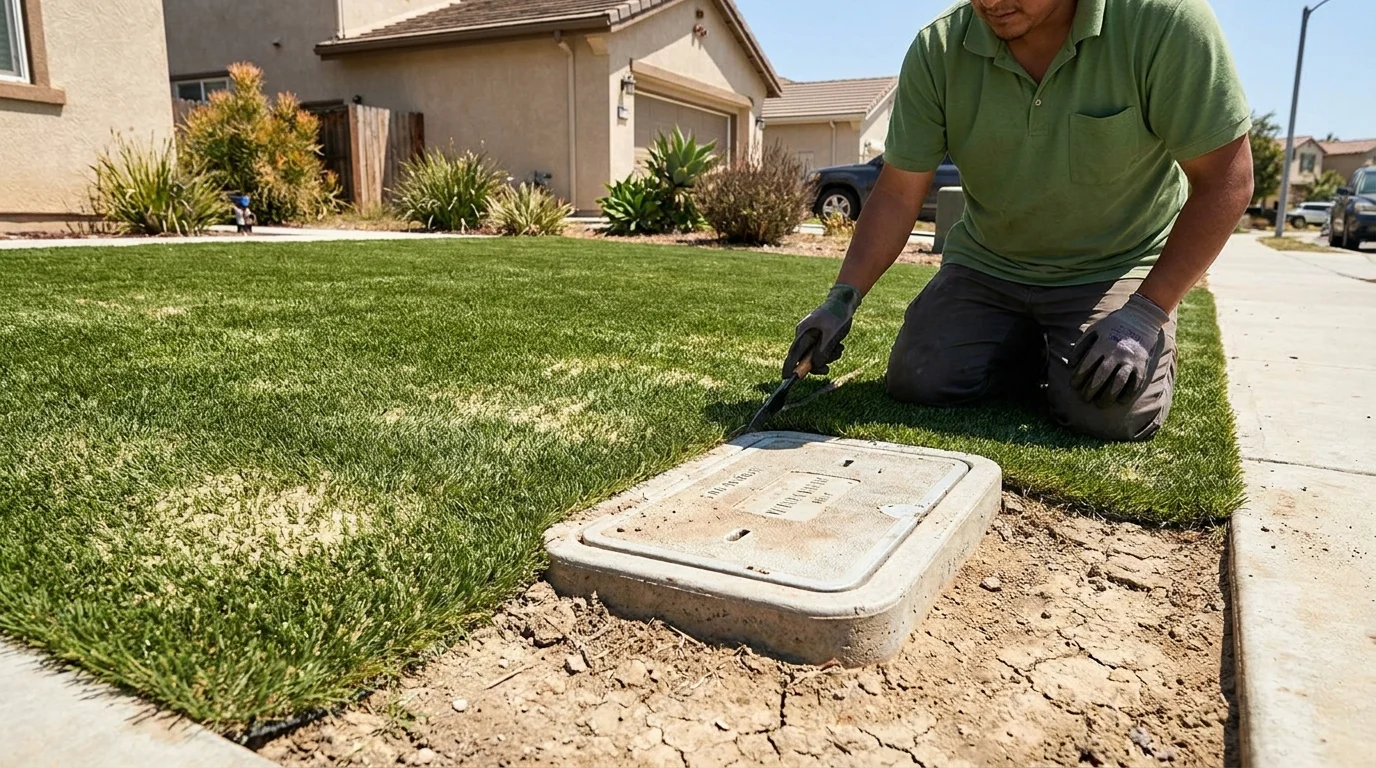
Replacing a 1,000-square-foot natural lawn with artificial turf saves roughly 44,000 to 73,000 gallons of water per year in San Diego. That translates to about $290 to $490 in annual water bill savings at current SD rates, and it qualifies for a rebate that can put several hundred dollars back in your pocket on installation day.
How much water a San Diego lawn actually uses
San Diego sits in a semi-arid Mediterranean climate. We get almost no summer rain, so every drop that keeps a grass lawn alive from May through October comes out of your hose or irrigation system. The San Diego County Water Authority (SDCWA) and its member agencies have tracked this for years: a conventional cool-season grass lawn in San Diego needs roughly 40 to 60 inches of applied irrigation water per year, depending on where you live.
Inland vs. coastal evapotranspiration
That 40-to-60-inch range isn’t random. It reflects real differences in how fast plants lose water to the air, a measure called evapotranspiration (ET). The California Irrigation Management Information System (CIMIS) publishes daily ET data by station across the state.
Coastal San Diego communities like La Jolla, Pacific Beach, and Chula Vista sit closer to the 40-inch end of that range. The marine layer keeps temperatures mild and humidity a little higher, so grass doesn’t dry out as fast. Inland areas like El Cajon, Santee, Lakeside, and Ramona run hotter and drier in summer, pushing ET rates toward 55 to 65 inches or more. A lawn in Escondido needs considerably more water than the same lawn four miles from the coast in Encinitas.
What irrigation inefficiency adds on top
Most residential irrigation systems waste water. Overspray, runoff on slopes, evaporation from midday watering, and heads that haven’t been adjusted in years all push actual water use well above the theoretical minimum a lawn needs. The EPA’s WaterSense program estimates that as much as 50 percent of outdoor residential water is wasted through inefficiency. We’re not using that figure in our math below, but it’s worth keeping in mind when you see your actual water bill versus what a perfectly calibrated system would use.
The savings math: a worked example
Let’s use a 1,000-square-foot lawn as the baseline. That’s roughly the size of a small front yard or a modest backyard putting area.
Step 1: Gallons per year for a natural lawn
One inch of water applied over 1,000 square feet equals about 623 gallons. We’ll use the midpoint of the SD irrigation range, 50 inches per year, as our estimate.
50 inches × 623 gallons = roughly 31,150 gallons per 1,000 sq ft per year
At the lower end of the range (40 inches for coastal areas): about 24,920 gallons. At the higher end (60 inches for hot inland areas): about 37,380 gallons.
Actually, those are the theoretical minimums. Real irrigation systems overshoot. If we apply a 40 percent inefficiency factor (conservative by EPA standards), actual use climbs to roughly:
- Coastal estimate: 24,920 × 1.4 = about 34,900 gallons/year
- Midpoint estimate: 31,150 × 1.4 = about 43,600 gallons/year
- Inland estimate: 37,380 × 1.4 = about 52,300 gallons/year
For a larger lawn, scale linearly. A 2,000-square-foot backyard would use roughly double these figures.
Step 2: What artificial turf uses
Artificial turf installation requires no irrigation once it’s down. The only water contact is occasional rinsing to remove dust or pet waste, which is minimal and optional. For practical purposes, turf saves essentially all of the water a grass lawn would have consumed.
Step 3: The savings number
For a 1,000-square-foot lawn, the savings range from roughly 35,000 to 52,000 gallons per year depending on location and how well your current system is tuned. We’ve seen customers in Santee and El Cajon on the high end and Carlsbad customers on the lower end, which lines up with the ET data.
What those gallons mean in dollars
San Diego water rates vary by agency and tier. Most residential customers in the county land in a range of roughly $6.50 to $9.00 per hundred cubic feet (HCF) for the first tiers of outdoor use, once you factor in fixed charges, infrastructure fees, and tiered rate structures. One HCF equals about 748 gallons.
Using $8.00 per HCF as a reasonable midpoint estimate for a typical San Diego residential customer on outdoor irrigation:
- 35,000 gallons ÷ 748 = about 46.8 HCF × $8.00 = roughly $374/year saved
- 52,000 gallons ÷ 748 = about 69.5 HCF × $8.00 = roughly $556/year saved
A reasonable middle estimate for a 1,000-square-foot San Diego lawn converted to turf: $300 to $500 per year in water savings. For a 2,000-square-foot backyard turf project, double it.
These are estimates, not guarantees. Your actual savings depend on your current usage, your water agency’s rate schedule, and how aggressively you currently water. But the math is grounded in real ET data and published rate ranges, not wishful thinking.
The SoCal Water$mart turf rebate
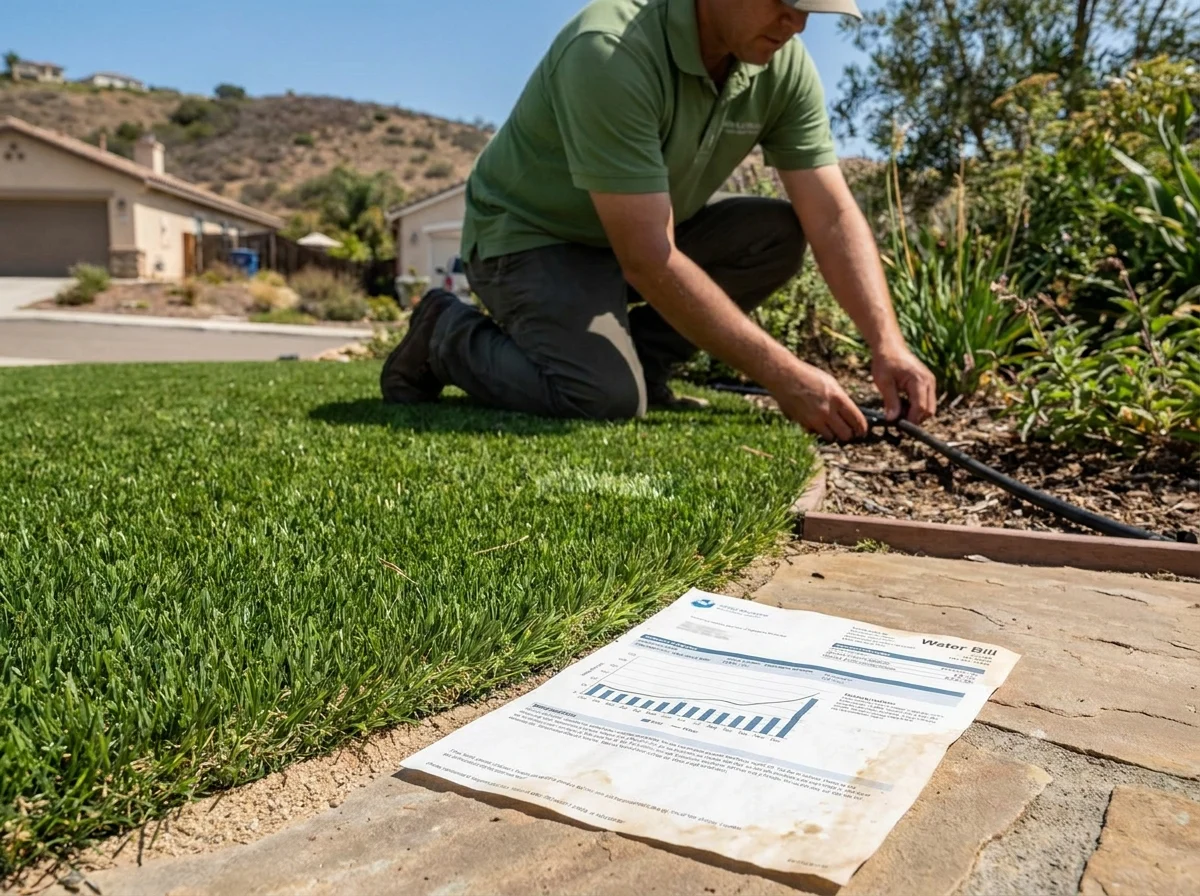
The Metropolitan Water District of Southern California (MWD) runs a program called SoCal Water$mart that reimburses homeowners for removing grass and replacing it with drought-tolerant alternatives, including artificial turf. As of 2026, the rebate is $2 per square foot for turf replacement, with a cap of $6,000 per residential account per year.
Some local water agencies stack their own rebates on top of the MWD program. Depending on your water provider, you may be able to collect $2.50 to $3.50 per square foot combined. For a 1,000-square-foot project, that’s $2,000 to $3,500 back.
There are conditions. The turf must meet minimum quality specs, the work must be done by a licensed contractor, and applications typically require before-and-after photos plus proof of installation. We walk every customer through the rebate application as part of our process. See our detailed breakdown in SoCal Water$mart turf rebate 2026.
Drought restrictions also matter here. SDCWA has historically activated watering restrictions during drought emergencies that limit outdoor irrigation to one to three days per week. Turf sidesteps those restrictions entirely, which means you’re not watching your lawn brown out during a Stage 3 emergency.
Payback period
Let’s build a simple payback estimate for a 1,000-square-foot front yard turf project.
Installed artificial turf in San Diego typically runs $12 to $18 per square foot all-in, including materials, base prep, infill, and labor. At the midpoint, $15 per square foot, a 1,000-square-foot project costs about $15,000 before rebates.
After a $2,000 MWD rebate (assuming no local stacking), net cost is about $13,000.
Annual water savings: roughly $400 (midpoint estimate).
$13,000 ÷ $400/year = about 32 years payback on water savings alone
That’s honest math. Turf doesn’t pay for itself purely on water savings in a short window. The full value picture includes:
- No mowing, edging, fertilizing, or pest control (roughly $800 to $2,000/year for a typical San Diego homeowner using a lawn service)
- No irrigation system maintenance or replacement
- Consistent curb appeal that doesn’t brown out in summer
- Elimination of future lawn replacement costs (sod, overseeding, aeration)
Add $1,200/year in maintenance savings to the $400 water savings, and payback on the $13,000 net cost drops to about 8 years. For a larger project or an inland yard with higher water bills, the numbers move faster.
You can work through your own numbers at our turf cost calculator or compare turf against sod alternatives in our artificial turf vs. sod comparison.
Other water-smart benefits
Water savings get the headlines, but a few adjacent benefits are worth mentioning.
Stormwater runoff. Over-irrigated lawns and runoff during rain events carry fertilizers and pesticides into storm drains. Turf eliminates irrigation runoff entirely, and some infill systems allow moderate rainfall to percolate through rather than sheet off.
HOA and city compliance. Some San Diego communities have water budgets or landscape ordinances that restrict turf species or require drought-tolerant planting. Artificial turf typically satisfies these requirements without ongoing management.
Pool and hardscape compatibility. Turf doesn’t need separate drip zones, won’t send roots into pavers, and doesn’t create mud near pool decks or patios. Those are small operational wins that reduce friction year over year.
For a full look at what installation costs, see artificial turf cost in San Diego 2026.
Common questions
Does artificial turf save water if I already have drought-tolerant grass?
Yes, though the savings are smaller. Drought-tolerant varieties like tall fescue or buffalo grass use roughly 30 to 40 percent less water than Kentucky bluegrass or ryegrass, but they still need 20 to 35 inches of irrigation in San Diego. Turf reduces that to near zero. The savings are real, just proportionally less dramatic than replacing a water-hungry cool-season lawn.
Do San Diego water districts accept artificial turf for rebates?
Most do. The MWD Water$mart program is the primary vehicle, and it covers customers served by most SDCWA member agencies. Some local agencies like Olivenhain Municipal Water District and Padre Dam add their own incentives. You apply through MWD’s portal with photos and contractor documentation. We help every customer through this process as part of the job.
Does turf require any water at all?
Minimal and occasional. Some homeowners hose down turf to cool it on very hot days (turf surface temperatures run higher than grass in direct sun) or to rinse off pet waste and debris. This amounts to a small fraction of what a lawn needs, typically a few hundred gallons per year versus tens of thousands.
How long until the water savings add up to the cost of installation?
Using water savings alone, the payback period is typically 25 to 35 years, depending on your yard size, water rates, and rebate amount. Most customers frame the decision differently: total cost of ownership including maintenance savings, turf lifespan of 15 to 20 years, and consistent lawn performance through drought years. On that basis, the math is considerably better. See the artificial turf cost guide for a deeper breakdown.
If you want a site-specific estimate and a walkthrough of the rebate process, we’re happy to come out and measure. Call us at (858) 925-5546 or fill out the form on our contact page. We serve all of San Diego County, from installation projects across the region to individual front and back yard builds. We’ll help you document everything the rebate application requires.