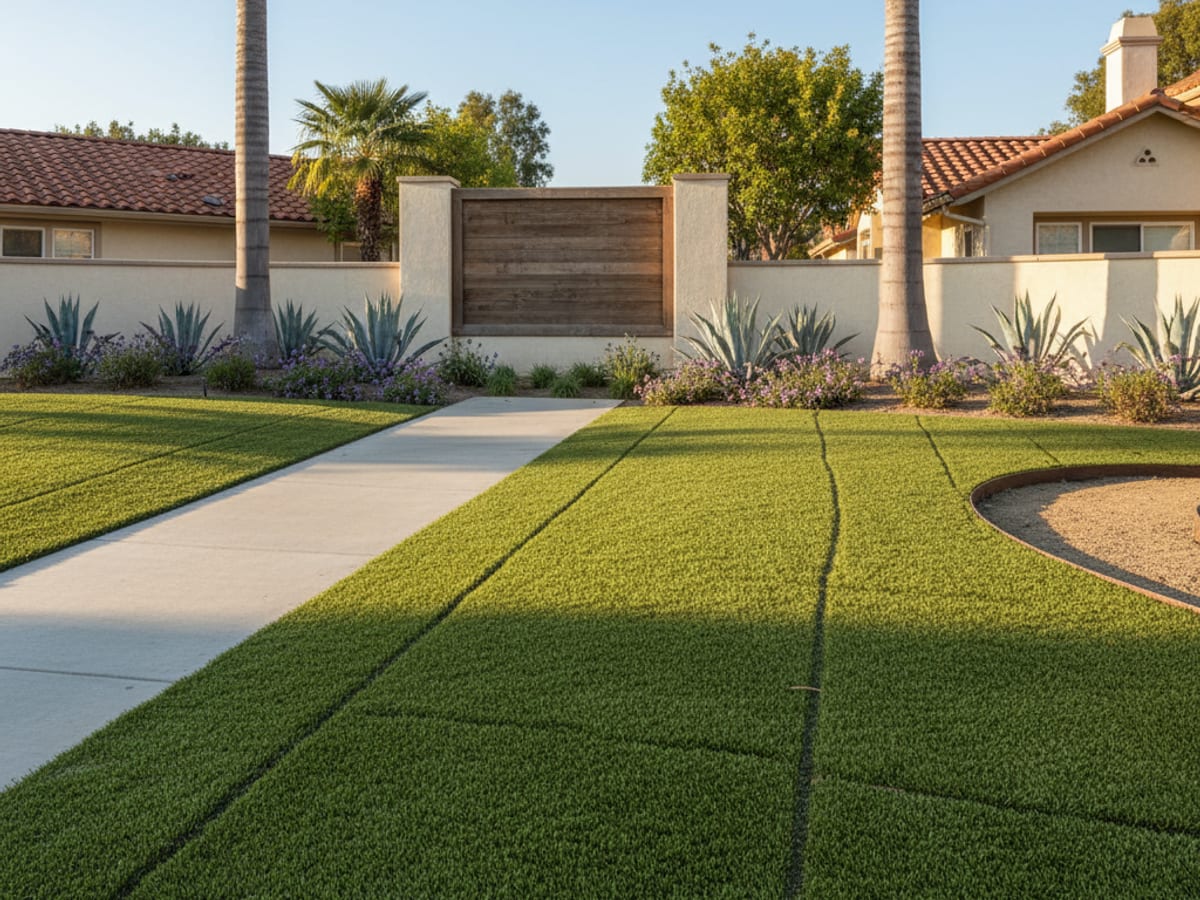
Commercial artificial turf in San Diego runs $8 to $16 per square foot installed for most properties in 2026. It cuts water bills, survives 280-day sun, and handles steady foot traffic without going brown. Hotels, offices, apartments, schools, and rooftop decks use it to stay green year-round on a fixed cost. The right spec depends on traffic, drainage, and whether your district pays a rebate.
National turf brands sell the product. They don’t quote your San Diego site. This guide does.
Why commercial turf makes sense in San Diego
San Diego gets about 10 inches of rain a year and 280-plus days of sun. Live commercial landscaping fights that climate every day. You pay for irrigation, mowing crews, fertilizer, and reseeding, and it still looks tired by August.
Artificial turf flips that math. No watering. No mowing. No brown patches by the entrance where everyone walks. For a property manager, that’s a predictable line item instead of a seasonal headache.
Water is the biggest driver. Commercial irrigation in San Diego County runs high, and rates climb most years. A 5,000 sq ft turf conversion can erase a real chunk of that bill on day one.
What it costs for commercial properties
Commercial pricing sits a little below residential per square foot because the areas are larger and crews work more efficiently. Here’s the honest 2026 range for San Diego commercial jobs.
| Application | Installed cost per sq ft | What drives it |
|---|---|---|
| Office or hotel courtyard | $9 to $14 | Foot traffic, design detail, edging |
| Apartment common areas | $8 to $13 | Volume, simple layout |
| Rooftop or deck turf | $11 to $16 | Drainage mat, access, weight limits |
| Playground or school turf | $12 to $18 | Safety pad, fall-height rating |
| Sports and putting surfaces | $10 to $20 | Pile spec, infill, true-roll base |
Three things move the number:
- Volume. Jobs over 5,000 sq ft usually drop $1 to $2 per sq ft. Mobilization and crew time spread across more area.
- Traffic rating. A lobby entrance needs a denser, lower-pile turf than a quiet courtyard. Denser turf costs more upfront and lasts longer where it matters.
- Drainage and access. Rooftop installs, narrow side yards, and second-story decks add labor. We flag that in the quote, not after.
We measure with a wheel, check drainage and access, and hand you a line-item written quote. Demo, base, turf, infill, labor. No surprise charges later.
Heat: the spec that actually matters here
Artificial turf gets hot in direct San Diego sun. Surface temps on dark, dense turf can hit 140 to 160 degrees on a clear summer afternoon. For a courtyard where people sit, that’s the difference between a usable space and one nobody touches from June to September.
Two specs control it. Lighter blade color reflects more heat. And some turf lines carry a heat-reflective backing or infill that drops surface temp 10 to 20 degrees. For shaded common areas it matters less. For a sun-baked entrance or a rooftop, it’s the first thing we spec.
If kids or pets use the space, we go further. Cooler infill and a smart shade plan keep the surface comfortable. This is exactly the kind of San Diego detail a national catalog skips.
Drainage for the rare heavy rain
San Diego rain is rare and then sudden. A winter storm can drop an inch in an hour. Commercial turf has to drain that without pooling at the entrance or flooding a planter.
Quality turf drains 30-plus inches per hour through perforated backing. The base under it does the real work: 3 to 4 inches of compacted Class-II road base graded to push water toward existing drains. On rooftops and decks the crews we send add a drainage mat and tie into the deck’s scuppers so water never sits on the membrane.
Get the base wrong and you get standing water, odor in pet areas, and seam pull. Get it right and the surface dries within minutes of a storm passing.
Drought rebates can pay for part of it
This is the part most turf sellers never mention. San Diego County water districts pay rebates to replace live grass with low-water landscaping, and artificial turf often qualifies.
SoCal Water$mart and local programs through the San Diego County Water Authority pay per square foot of grass removed. For commercial properties the rebate can offset a meaningful slice of the conversion. The rules are specific: the rebate must be approved before installation, never after, and turf alone sometimes needs companion plantings to qualify.
We help commercial clients pull the paperwork together and time the install so the rebate clears. For the full breakdown, read our SoCal Water$mart rebate guide.
HOA and multi-family rules
If your property is an HOA, a condo association, or a multi-family community, turf comes with rules. California law protects a homeowner’s right to install water-efficient landscaping, but HOAs can still set reasonable standards on appearance, color, and edging.
For commercial and common-area installs, the board usually has its own spec: blade height, color blend, border treatment. The crews we send build to those standards so it passes review the first time. Our HOA artificial turf rules guide covers what associations can and can’t require.
Coastal vs inland
Where the property sits changes the spec. Coastal sites in places like La Jolla, Encinitas, and Carlsbad deal with salt air and marine fog, so seam adhesive and UV stability matter most. Inland sites in El Cajon, Santee, and Escondido run hotter, so heat-reflective specs and cooler infill carry more weight. We adjust the build to the microclimate, not a one-size catalog.
Frequently asked questions
How long does commercial artificial turf last in San Diego? A quality install lasts 12 to 18 years here. High-traffic entrances wear faster than quiet courtyards, so we spec denser turf where the foot traffic is heaviest.
Does commercial turf qualify for water rebates? Often, yes, through SoCal Water$mart and county programs. Approval has to happen before install. We handle the timing and paperwork.
Is it safe in high-traffic and ADA areas? Yes. Commercial turf installs over a firm compacted base and can meet ADA firmness and slip requirements when spec’d for it. Playground turf adds a fall-height-rated safety pad.
How hot does it get, and can people use it in summer? Dark dense turf in full sun can reach 140 to 160 degrees. Lighter blades, heat-reflective backing, cooler infill, and shade keep seating and play areas comfortable.
What maintenance does it need? Far less than live grass. Rinse for dust, brush high-traffic lanes to keep blades upright, and clear debris. No mowing, watering, or fertilizing.
Can it go on a rooftop or deck? Yes. Rooftop turf uses a drainage mat tied into the deck scuppers and accounts for weight limits and access. It’s one of the most popular commercial applications in San Diego.
Related guides
- Artificial turf cost in San Diego (2026)
- SoCal Water$mart rebate guide
- Service: commercial artificial turf
Get a real commercial quote
We quote commercial properties across San Diego County. Free site visit, written line-item pricing, no deposit to schedule. Call (858) 925-5546 or fill out the contact form and we’ll get you on the calendar.