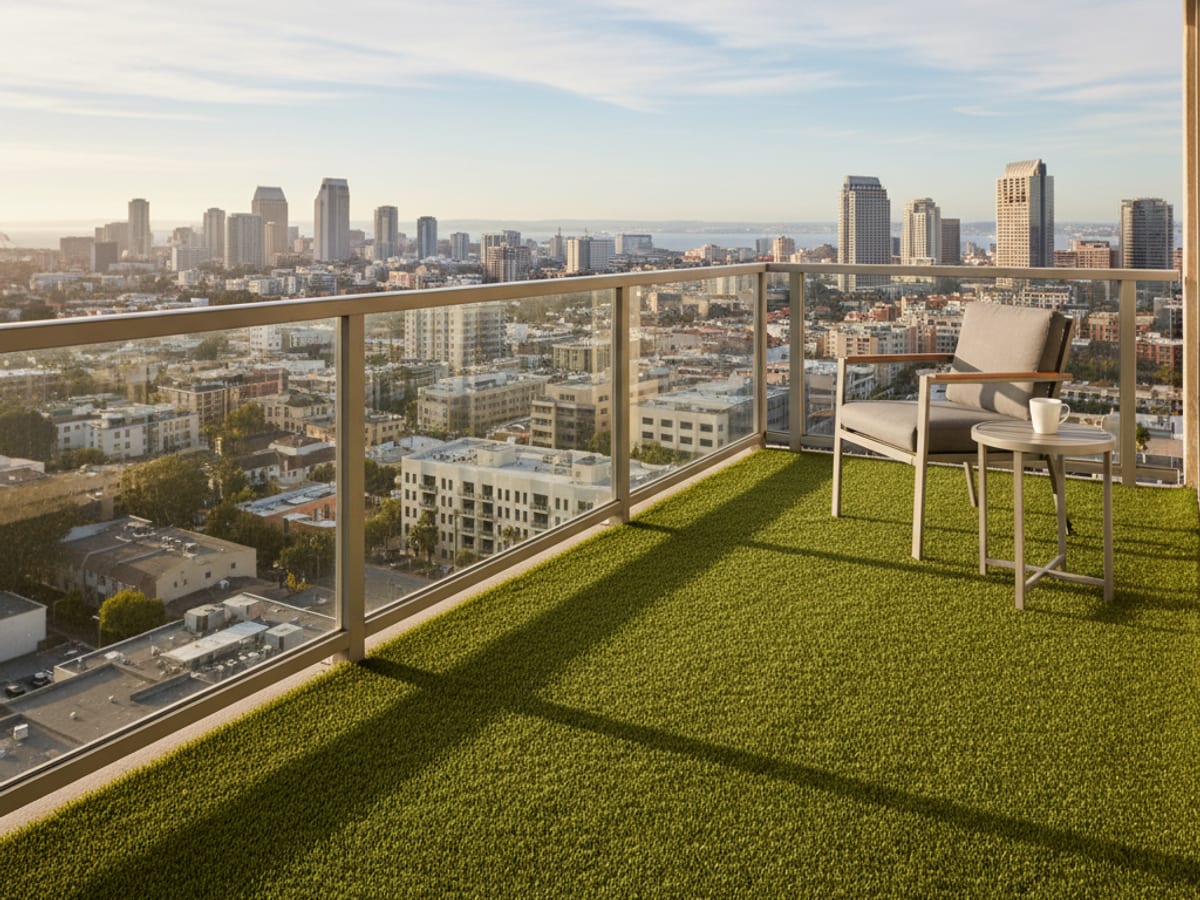
Rooftop and balcony turf in San Diego works well, but it’s a different job than a backyard. The four things that decide success here are weight, roof drainage, coastal wind, and your building’s rules. Get those right and turf turns a bare deck into usable green space that drains in rain and stays put in wind. Skip them and you get pooling, lifted edges, or a callback from the HOA.
Why rooftops are their own category
A backyard sits on graded soil that absorbs water and anchors the turf with infill weight. A rooftop sits on a waterproof membrane that can’t be punctured, drains to a few fixed points, and catches wind no ground-level yard ever feels. The turf is the same product. Everything under it and around it changes.
That’s the part most national turf pages skip. They show a green roof deck and call it an urban oasis. They don’t tell you how the water gets off your roof or what your condo board will ask for. Those are the questions that actually decide whether the install lasts.
The four things that matter
1. Weight. Modern San Diego decks and rooftops easily support turf, but you confirm it, you don’t assume it. Turf plus a lightweight drainage underlayer runs under 2 lbs per square foot. That’s well within almost any deck rating. The point isn’t that it’s heavy. The point is that one conversation with your building manager closes the question before install day.
2. Roof drainage. A rooftop doesn’t slope to soil. It slopes to scuppers and drains. Turf laid flat over those will trap water and breed the same pooling that ruins patio installs. We map the existing drainage path, keep turf clear of scuppers, and use a drainage tile or foam underlayer that lets water flow underneath to the roof’s own drains. The membrane stays untouched. Nothing gets glued or screwed into it.
3. Coastal wind. A Pacific Beach or downtown high-rise rooftop catches wind that a Santee backyard never sees. Loose-laid turf can lift at the corners. The crews we send weight the field with infill and secure the perimeter with non-penetrating edging or ballast so wind can’t get under it. This is the detail that separates a rooftop install from a patio install.
4. Building rules. Condo towers, HOAs, and rooftop common areas usually have written rules about deck finishes, fire rating, and load. Some require Class A fire-rated turf. We’ll cover the rules below.
Heat off a rooftop membrane
Rooftop turf runs hotter than backyard turf, and it’s worth knowing why before you commit.
Backyard turf gets its heat from the sun alone. Surface temps run 30 to 50°F over ambient on full-sun days. A rooftop gets that plus radiant heat coming off a dark membrane, parapet walls, and surrounding HVAC units. On an inland rooftop in El Cajon or Escondido in July, that stacks up fast.
What actually helps:
- Lighter turf grades. Premium turf with pale-green blades and brown thatch tones runs cooler than dense dark turf.
- A foam underlayer. Padding under the turf insulates it from the hot membrane below, which is a rooftop-specific win you don’t get in a yard.
- Coastal placement is your friend. A La Jolla or Coronado rooftop with ocean breeze stays far more comfortable than an inland one. The marine layer does real work.
For the full breakdown of how hot turf gets here and what to do about it, read our guide on how hot artificial turf gets in San Diego.
Coastal vs inland rooftops
San Diego isn’t one climate, and your rooftop’s location changes the install.
Coastal (La Jolla, PB, Coronado, Carlsbad). Cooler surface temps thanks to ocean breeze, but more wind and salt air. Wind anchoring matters most here. We also use marine-grade adhesive and edging that won’t corrode in salt air.
Inland (El Cajon, Escondido, Santee, San Marcos). Hotter, less wind. Heat management leads here: lighter turf, foam underlayer, and a shade plan if kids or pets use the space.
The same rooftop deck gets two different specs depending on which side of the county it’s on. That’s local knowledge a catalog can’t give you.
Drainage is the #1 rooftop callback
The most common rooftop turf failure isn’t the turf. It’s water with nowhere to go.
Cause: turf laid directly over the membrane without a drainage layer, or turf that blocks a roof drain or scupper. Water pools on top after one of San Diego’s rare heavy rains, and it sits there.
Prevention: a drainage tile or foam underlayer creates a gap between turf and membrane so water flows underneath to the roof’s existing drains. We keep turf cut back from every scupper and drain. We never block the path water already uses. This is the same principle as our patio turf install method, adapted for a roof that drains to fixed points instead of soil.
San Diego only gets about 10 inches of rain a year, almost all of it between November and March. That’s easy to dismiss. Don’t. When it rains here it tends to come hard and fast, and a rooftop that can’t shed water fast turns into a shallow pool over your living space.
HOA and condo tower rules
This is where rooftop installs differ most from a private backyard.
If your deck is in a condo tower or a complex with shared rooftop space, the HOA almost always has a say. Common requirements:
- Class A fire rating. Many towers require fire-rated turf on elevated decks. The product exists. We source it when the building asks.
- No membrane penetration. Boards rarely allow anything screwed or anchored into the roof. Non-penetrating installs are standard for us, so this is usually a non-issue.
- Load documentation. Some buildings want the weight per square foot in writing. We provide it.
- Approved-vendor or insurance paperwork. Larger buildings may ask for documentation before work starts.
California law protects a homeowner’s right to install water-efficient landscaping, but rooftop common areas and tower rules add a layer on top of that. We break down what HOAs can and can’t restrict in our California HOA turf rules guide.
The simplest move: ask your building manager what they require before you book anything. One email saves a lot of friction.
What it costs
Rooftop and balcony turf in San Diego runs more per square foot than a backyard because of the underlayer and access. Here’s a realistic framework.
| Item | Cost range | Notes |
|---|---|---|
| Turf material | $3 to $5 per sq ft | Lighter, fire-rated grades sit at the higher end |
| Drainage / foam underlayer | $1 to $3 per sq ft | The rooftop-specific add that protects the membrane and cools the surface |
| Labor and install | included in installed price | Access matters: stairs and tight elevators add time |
| Installed total | $12 to $18 per sq ft | Higher than a $9 to $14 patio because of the underlayer and access |
Most balconies run 100 to 300 square feet and finish in a single day. Larger rooftop decks take one to two days. For full pricing across every turf type, see our San Diego artificial turf cost guide.
We give you the install price on the spot, in writing, after we see the space. No estimate-by-phone games.
Pets on a rooftop
If your dog uses a rooftop balcony, the drainage layer does double duty. Liquid drains through the turf and the underlayer to the roof drains, the same as rain. You still rinse the area and use a zeolite infill to control odor, same as a ground-level pet yard. The difference is there’s no soil to absorb anything, so the drainage layer isn’t optional. It’s the whole system.
Frequently asked questions
Will rooftop turf damage my roof membrane? Not when it’s installed right. We never penetrate the membrane. Turf lays over a drainage underlayer that keeps it off the surface and lets water flow to the roof’s drains. The membrane is fully protected and the turf is removable later.
How much weight does rooftop turf add? Turf plus a lightweight drainage underlayer runs under 2 lbs per square foot. That’s within almost any modern deck rating, but we confirm the load with your building before install.
Do I need HOA approval for balcony turf? If your balcony or rooftop is part of a condo tower or shared complex, usually yes. Many buildings require fire-rated turf and load documentation. Ask your building manager before booking. See our HOA turf rules guide.
Does rooftop turf get too hot to use? Inland rooftops get hot in afternoon sun, hotter than backyards because of radiant heat off the membrane. Lighter turf grades and a foam underlayer help. Coastal rooftops with ocean breeze stay comfortable. Plan shade if kids or pets use an inland deck.
How does water drain off a rooftop turf install? Through a drainage tile or foam underlayer that creates a gap between turf and membrane. Water flows underneath to the roof’s existing scuppers and drains. We keep turf clear of every drain so nothing gets blocked.
Can you install turf on a coastal high-rise balcony? Yes. We do coastal balcony installs in high-rises and condo towers. Salt air and wind get a marine-grade adhesive and non-penetrating wind anchoring so the turf stays put.
Get a rooftop turf quote
We come out, measure the deck, check the drainage path and access, talk through your building’s rules, and give you the install price on the spot. Coastal or inland, balcony or full rooftop, we cover all of San Diego County.
Call (858) 925-5546 or use the contact form.