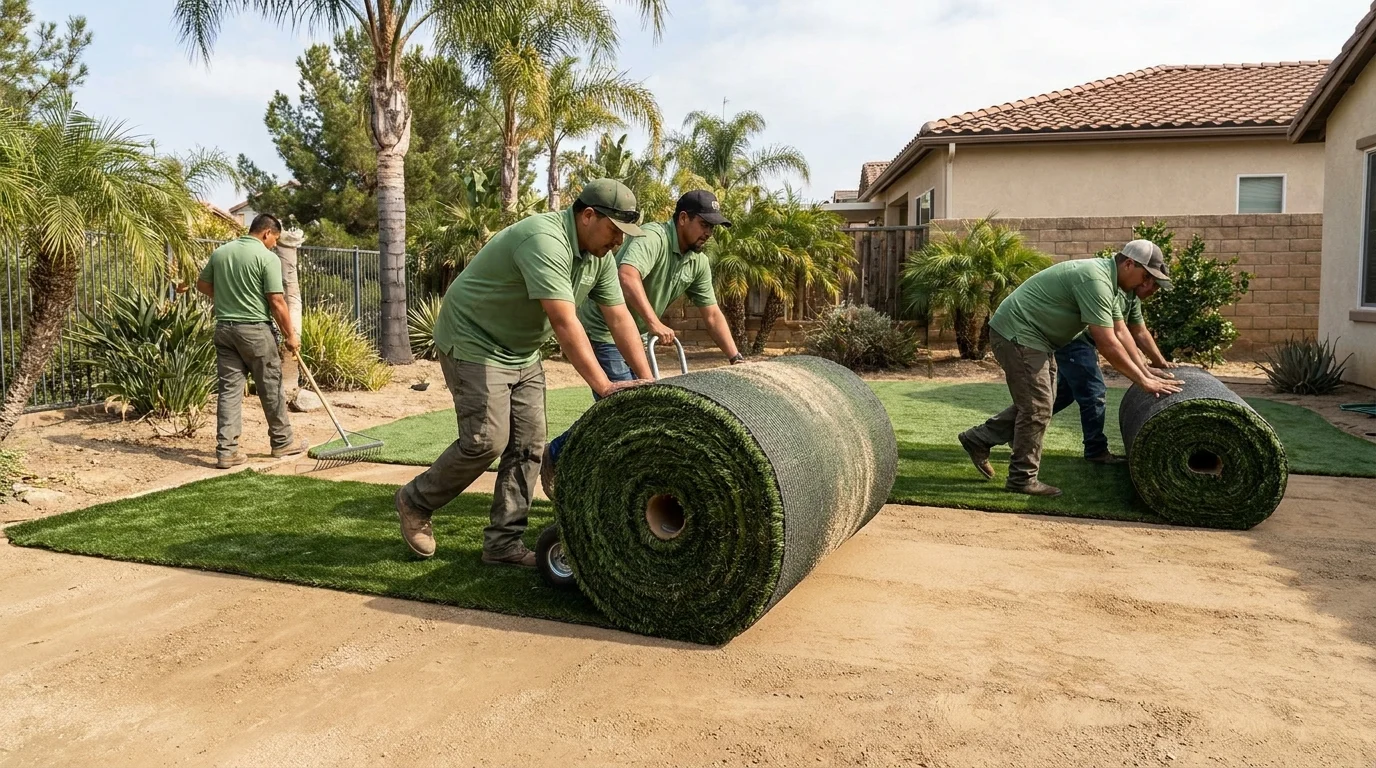
A professional artificial turf installation takes two to four days for a typical San Diego backyard. The most important work happens before the turf ever rolls out: proper excavation, base compaction, and drainage prep determine whether your lawn looks great for five years or twenty. Here’s exactly what a quality install looks like from start to finish.
Demo and excavation
The crew starts by removing whatever’s there now. Sod, gravel, decomposed granite, old concrete pavers. It all gets hauled off the property.
Excavation depth depends on what’s underneath. Most San Diego yards need 3 to 4 inches removed to make room for the base. Inland areas like El Cajon and Escondido sit on heavy clay soils that don’t drain on their own. In those yards, crews often cut a little deeper and sometimes score or perforate the native soil before laying base so water has somewhere to go. Skip that step on clay and you’ll end up with standing water pooling under the turf.
On sloped lots in Poway or the hillside neighborhoods above Encinitas, excavation includes reshaping any high spots and marking where water will naturally want to run. The slope is your friend when it’s planned for.
Grading
Once the old material is out, the crew grades the exposed soil. The goal is a smooth, slightly crowned or angled surface with no low spots that will collect water.
This step matters more than most homeowners expect. Bumps in the native soil show through a finished turf surface. Shallow depressions become puddles after rain. A flat eye-check isn’t good enough. Crews use a long screed board or laser level to find and fix uneven spots before anything else goes in.
On coastal lots in Carlsbad and Encinitas, drainage flows toward the street or a designated dry well. The grade gets set to match that flow intentionally, not left to chance.
Base material and compaction
This is where the real work is. A proper artificial turf installation uses 3 to 4 inches of Class II road base or decomposed granite spread evenly across the excavated area.
Road base compacts tighter and handles heavy foot traffic better than decomposed granite alone. Both materials drain well when installed correctly. The base goes in in lifts, typically two passes, and each lift gets compacted with a plate compactor until the material hits roughly 90 percent compaction. Tap it with your foot and it should feel like concrete, not sand.
Don’t shortcut this step. A thin or under-compacted base settles unevenly over time. That’s where you get the soft spots and ripples that show up two years after install. If a contractor is quoting you a job that doesn’t include mechanical compaction, ask specifically how they handle it before you sign anything. For more context on what separates a solid install from a cheap one, this comparison of DIY versus professional turf installation is worth reading.
Weed barrier
A permeable weed barrier goes down on top of the compacted base. It lets water pass through while blocking weed seeds from pushing up through the base over time.
Some contractors skip this layer to cut costs. That’s a mistake. Even with a well-compacted base, wind-blown weed seeds will find their way in. A quality barrier adds maybe $0.15 to $0.25 per square foot to the job and pays for itself by year two.
Turf layout and seaming
The turf rolls arrive cut close to the finished dimensions of the area. The crew lays them out and lets them acclimate for 30 to 60 minutes if it’s a hot day. Turf expands slightly in heat and contracts in the morning. Laying cold turf in the afternoon sun and staking it immediately is how you end up with buckling.
All turf has a pile direction, the way the fibers lean. On a well-installed job, every piece in a yard faces the same direction. The blades lean toward the house or toward the street, whichever gives the best visual from the primary viewing angle. If different sections of a yard face different directions, the pieces will look like mismatched shades of green in certain light.
Seams are the most skill-dependent part of the job. Crews use a seam tape and turf adhesive under every joint. The fibers from each side get brushed outward over the tape so the seam line disappears into the pile. A well-done seam is invisible at three feet. A bad seam looks like a scar across your lawn and tends to open up over time.
For backyard turf installs with irregular shapes, curves, or built-in features like putting greens or sandboxes, the seaming and cutting work gets more complex. It’s where experience shows.
Fastening
The perimeter of every turf section gets secured with 60-penny nails or heavy-duty staples driven every 3 to 6 inches along the edges and through any seam tape joints. On hardscape borders like concrete or pavers, crews use construction adhesive instead of nails.
Interior sections get nailed on a grid pattern so the turf can’t shift or wrinkle under use. Pet runs and pet turf installations get extra fastening along high-traffic paths because dogs tend to work the same routes over and over.
Infill
Infill is the material broadcast across the turf surface after it’s secured. It does three things: it weighs the turf down, it supports the fibers upright, and it adds cushion underfoot.
The two most common infills in San Diego are silica sand and zeolite. Silica sand is the standard for most residential yards. It’s inexpensive, stable, and holds the pile upright well. Zeolite is a porous mineral that absorbs ammonia from pet urine. For yards with dogs, a blend of silica sand and zeolite, or zeolite-heavy infill near common elimination zones, makes a real difference in odor control. A dedicated pet turf installation often uses zeolite as the primary infill throughout.
Infill rates vary by turf product but typically run 1.5 to 3 pounds per square foot. It gets distributed with a drop spreader in multiple passes, working both horizontally and vertically across the pile. For a deeper look at infill options and tradeoffs, this breakdown of turf infill types covers the full range.
Installed turf in San Diego runs roughly $9 to $20 per square foot depending on turf grade, site prep complexity, and infill choice. The turf cost calculator gives a more precise estimate for your specific project. For a full breakdown of what drives pricing, turf cost in San Diego for 2026 is current and specific.
Power brushing
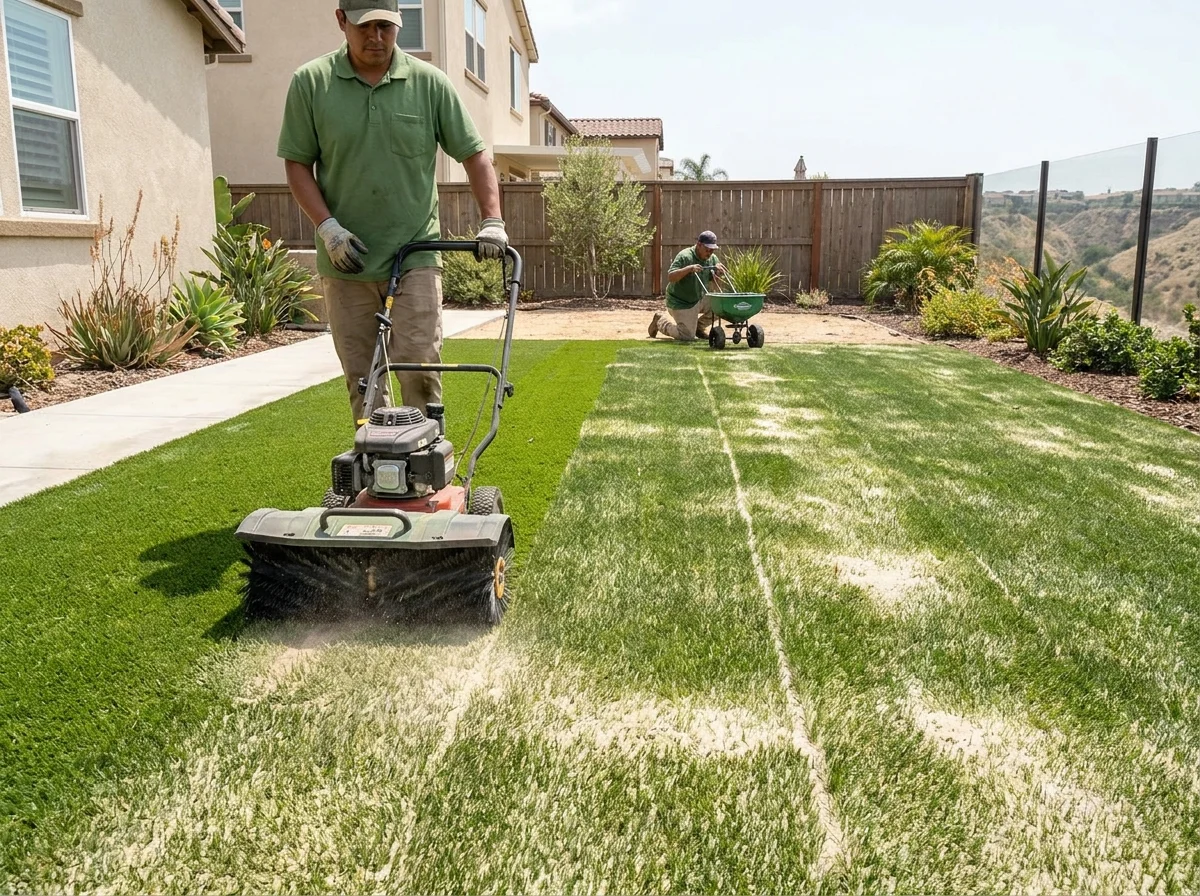
Once the infill is spread, a power broom lifts the turf fibers upright and works the infill down into the pile. This is what makes finished turf look full and natural rather than flat.
Power brushing runs multiple times across the surface in opposing directions. Each pass pulls more fibers upright and distributes infill more evenly. On longer-pile turf products, this step takes longer and matters more. A rushed power brush leaves turf looking matted and thin.
Cleanup and final walkthrough
The crew clears all scrap turf, base material, and packaging from the property. Edges get a final inspection to make sure nothing is lifting. Seams get a close look. Any infill that ended up on hardscape gets blown or swept back onto the turf surface.
A final walkthrough with the homeowner covers how to rinse the surface, how to handle pet waste, and what to expect in the first few weeks as the turf settles and infill redistributes. Most yards get a light rinse the first time they’re used to settle the infill and cool the surface.
The full artificial turf installation service page covers what’s included in a standard Green Pro Turf job and what the process looks like from estimate to completion.
Common questions
How long does a turf installation take?
Most residential backyards in San Diego take two to four days. Day one is typically demolition, excavation, and grading. Day two is base installation and compaction. Day three is turf layout, seaming, fastening, and infill. Larger yards or complex shapes can add a day. The compacted base needs to set before turf goes down, so rushing the schedule affects quality.
Does artificial turf work on slopes?
Yes, but it requires extra attention to drainage and fastening. Steep slopes need a perimeter border nailed into the soil at close intervals so the turf doesn’t creep downhill over time. The base on a slope also needs to be graded so water exits cleanly at the bottom rather than pooling mid-slope. Poway hillside lots and canyon-adjacent properties in Santee and Spring Valley come up regularly in our work.
What happens if the base isn’t compacted enough?
The turf will feel soft in places, develop low spots after rain, and eventually wrinkle or ripple as sections settle at different rates. In clay-heavy inland soils, under-compacted base also traps water and creates drainage problems. It’s the most common reason a five-year-old turf lawn looks ten years old.
Can turf be installed over concrete?
Yes. Concrete installs skip excavation and base prep entirely. The crew spreads a foam or rubber pad for cushion, glues the turf directly to the concrete surface, and trims to fit. Drainage happens through perforated turf backing and into existing concrete drains. It’s common on patios, balconies, and pool decks.
Get a straight estimate
If you want to know what installation looks like for your specific yard, we’ll come measure and give you a written quote with no pressure. Call us at (858) 925-5546 or send us a note through the contact form. We work throughout San Diego County.