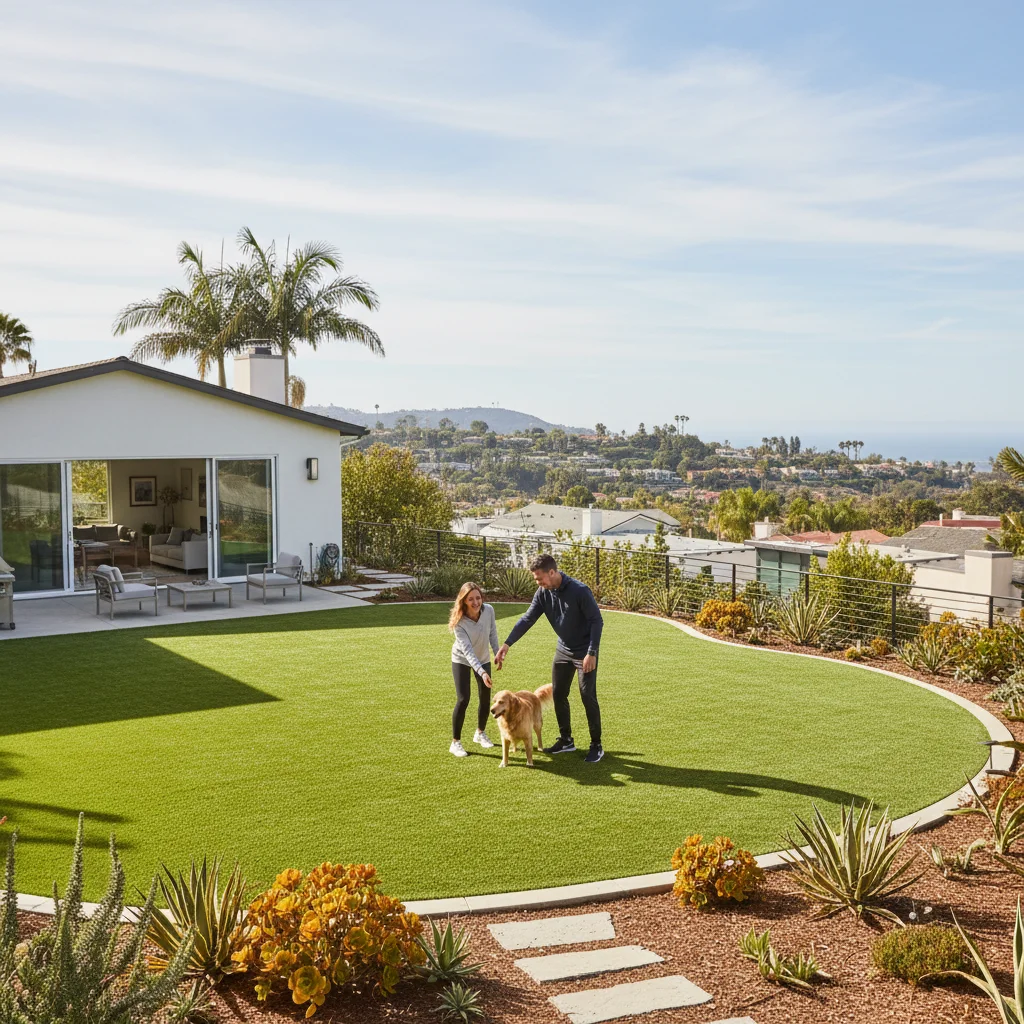
DIY artificial turf installation in San Diego costs $5 to $8 per square foot in materials, versus $11 to $18 per square foot for a professional install. For a 500 sq ft yard, that’s roughly $2,500 to $4,000 to do it yourself against $5,500 to $9,000 installed. The savings are real. So is the failure rate. Most DIY problems here trace back to two San Diego specifics: clay-heavy inland soil and base compaction nobody rents a plate compactor for.
What DIY actually saves you
The national guides quote material at $5 to $8 per sq ft and call it a day. They skip what San Diego adds.
Here’s the honest comparison for a 500 sq ft backyard.
| Line item | DIY | Professional |
|---|---|---|
| Turf roll | $2,000-$4,000 | included |
| Base material (Class-II) | $300-$500 | included |
| Infill | $150-$400 | included |
| Plate compactor rental | $90-$140/day | included |
| Tools, glue, staples, seam tape | $200-$350 | included |
| Demo and hauling | your weekend | included |
| Total | $2,740-$5,390 | $5,500-$9,000 |
You save $2,000 to $4,000. You spend two to four weekends, rent equipment, and own every mistake. Whether that math works depends on your yard, not your budget.
The base prep that fails in San Diego
This is where most DIY installs go wrong here. San Diego soil is not uniform. Coastal yards near the beach tend to be sandy and drain fast. Central and East County yards sit on clay that swells when wet and shrinks when dry. That movement is what pulls seams apart and creates the divots you see in failed DIY jobs.
A sound base is four inches of Class-II road base, laid in two-inch lifts, each lift compacted to about 90 percent. Most DIYers spread the rock, walk on it, and call it compacted. It isn’t. A hand tamper does maybe 60 percent. You need a rented plate compactor and a light water spray between lifts. Skip this on clay soil and the surface ripples within a year.
If your yard is flat and sandy, the base is forgiving. If it’s sloped or clay, the base is the whole job.
Drainage for rain that barely comes
San Diego averages around 10 inches of rain a year, almost all of it between December and March. The rest of the year, drainage feels like a non-issue. Then a single atmospheric river drops two inches in a day and a flat, poorly graded yard turns into a puddle that sits under the turf.
Artificial turf backing has perforations that let water through. That only works if the base under it drains and the yard is graded to move water somewhere. A pro slopes the base about one to two percent toward a drain or a permeable edge. DIYers tend to lay everything dead flat because it looks right. It drains wrong.
For clay yards, a perforated drain line tied into existing yard drainage runs $500 to $1,500 if a pro does it. Doing it yourself means a trench, the right pipe, and a real outlet. It’s doable. It’s also the step people skip and regret.
Heat, glue, and seams that hold
Inland San Diego surface temps on dark hardscape hit the triple digits in summer, and turf gets hot too. That heat is why hardware-store latex seam adhesive fails here. It softens, the seam lifts, and you see the line across your yard.
The fix is marine-grade polyurethane glue on outdoor seam tape, the same product pros use. It’s not expensive, but it’s not on the shelf at most big-box stores. If your DIY plan uses the cheap white adhesive, plan to redo the seams in a couple of summers.
For lighter installs that avoid this risk entirely, see our patio turf installation guide, where smaller single-piece cuts skip the seam problem and make DIY far more forgiving.
HOA rules before you buy a single roll
A lot of San Diego County homes sit in HOAs, and California law has shifted in homeowners’ favor on drought-tolerant landscaping. That doesn’t mean your HOA has no say. Many still regulate turf grade, pile height, color, and edging.
If you DIY without checking, you can install a perfectly good yard and get a correction notice over a detail you never knew mattered. Read your CC&Rs first. We cover the current rules in our California HOA artificial turf guide.
The rebate you only get once
Most San Diego water districts pay $3 to $4 per square foot through SoCal Water$mart to convert living grass to artificial turf. On a 500 sq ft yard that’s $1,500 to $2,000 back, which can erase most of your DIY material cost.
The catch matters: the rebate has to be approved before you start. There’s no claiming it after the turf is down. The application also has documentation requirements, before-photos, and sometimes an inspection. We walk through the whole process in our SoCal Water$mart rebate guide, and we help our install clients with the paperwork.
When DIY makes sense, and when it doesn’t
DIY is a reasonable call when your yard is small, flat, sandy near the coast, and you’re handy with a compactor. A 200 sq ft side yard with good drainage is a real weekend project.
Hire a pro when:
- Your yard is sloped or sits on clay (most of central and East County)
- You need a drain line tied into existing yard drainage
- The job is pet turf, which needs a deeper base and antimicrobial infill
- You’re chasing a rebate and need documentation done right the first time
- Access is tight and demo has to be hauled out by hand
The cost gap is real money. So is tearing out a failed install and paying for it twice.
FAQ
How much does DIY artificial turf cost in San Diego? Materials run $5 to $8 per square foot, so a 500 sq ft yard is roughly $2,500 to $4,000, plus compactor rental and tools. A professional install of the same yard runs $5,500 to $9,000.
Can I install artificial turf myself on San Diego clay soil? You can, but the base is unforgiving. Clay moves with moisture, so you need four inches of properly compacted Class-II base and real grading for drainage. This is where most DIY jobs fail here.
Do I still qualify for the water rebate if I install it myself? Yes. SoCal Water$mart rebates go to the property owner, not the installer. You must get approval before you start, and you handle the documentation and photos yourself.
What glue should I use for turf seams in San Diego heat? Marine-grade polyurethane on outdoor seam tape. Skip the white latex adhesives sold in big-box stores. They soften in summer heat and seams lift.
How long does a DIY turf install take? A small, flat 200 to 300 sq ft yard is a two-day project for two people. A 500 sq ft yard with demo and drainage work realistically takes two to four weekends.
Will my HOA let me install turf myself? Often yes, but many San Diego HOAs still regulate grade, color, and edging. Check your CC&Rs before buying turf, regardless of who installs it.
Get a real number before you decide
The DIY-versus-pro math is easier when you know what the professional install actually costs for your yard. We give upfront quotes across San Diego County, with no pressure either way. If your yard is flat and sandy, we’ll tell you it’s a good DIY candidate. If it’s clay and sloped, we’ll show you why the base matters.
Want the full cost picture first? Read our San Diego turf cost guide, or see what’s included in a professional artificial turf installation.
Call (858) 925-5546 for an upfront quote. We cover all of San Diego County and help with the rebate paperwork.