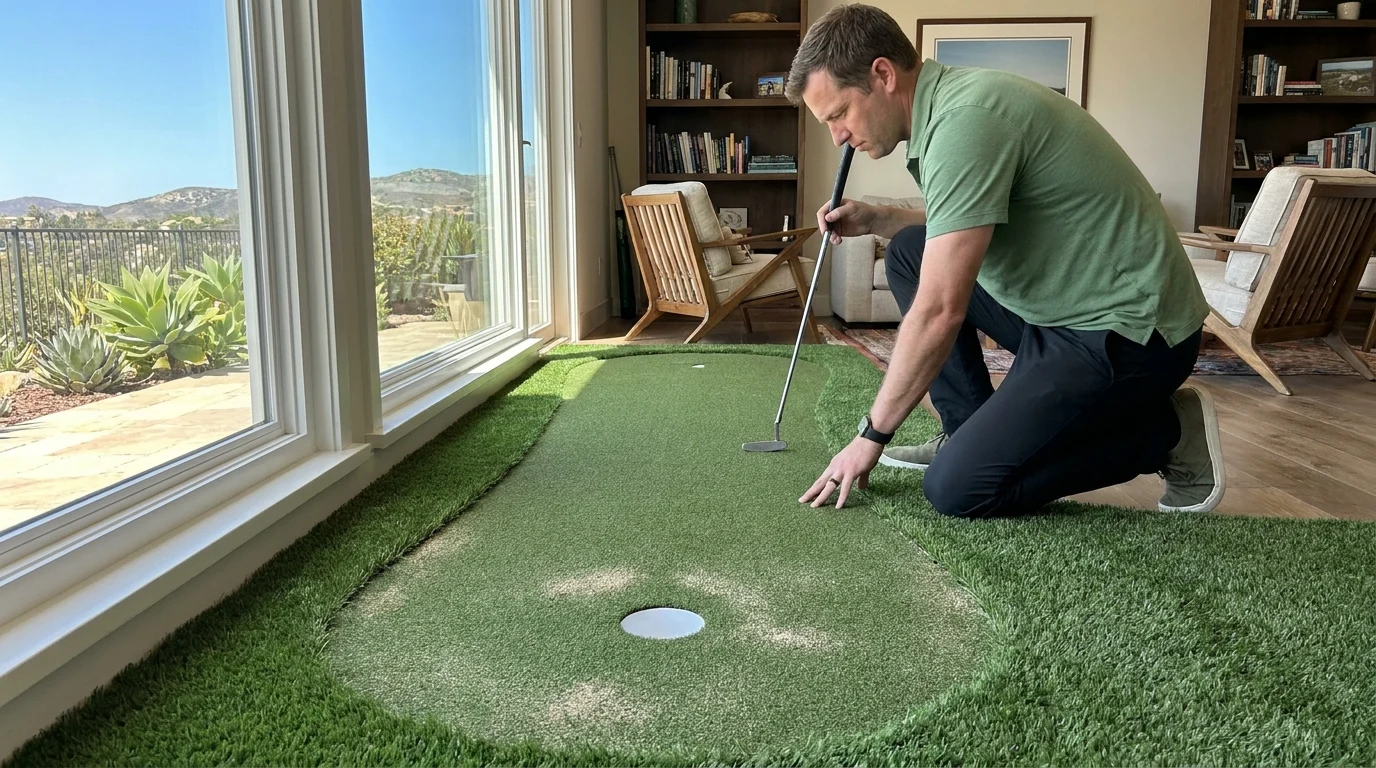
A basic indoor putting green in San Diego runs $1,500 to $8,000 installed, depending on size, surface type, and how much contouring you want. Most homeowners install them in a garage, bonus room, or home office, and the whole project typically takes one day. The surface lasts 10 to 15 years with normal use, so it’s one of the better long-term investments for golfers who want consistent practice time at home.
Why indoor greens are worth a second look
San Diego weather is obviously great, so most of our putting green installations go outdoors. But there’s a real case for going inside.
An indoor green is playable any time of day, regardless of wind or overnight dew. It’s also useful in apartments or condo communities where outdoor turf modifications aren’t permitted. And if you’re serious about your short game, a dedicated indoor space removes the friction of going outside every time you want to roll 20 putts.
Indoor greens go into garages, bonus rooms, and home offices across the county. The common thread: the person using it wanted something that was always ready and didn’t require going outdoors.
The surface is what makes or breaks it
Outdoor putting greens often use polyethylene turf because it holds up to UV exposure. Indoors, you don’t have that concern, which opens up better options.
Nylon turf is the standard for indoor putting greens. It’s denser and firmer than polyethylene, rolls faster, and doesn’t compress over time the way softer fibers do. It mimics a well-maintained bentgrass or Bermuda green better than any other synthetic fiber. The tradeoff is price: nylon runs $4 to $7 per square foot for the material alone, before installation.
Polypropylene turf is cheaper ($2 to $4/sq ft) but goes flat under foot traffic faster and doesn’t roll as true over time. Fine for a casual setup, not ideal if you’re practicing for a reason.
Pile height matters as much as fiber type. Most quality indoor greens use turf with a 0.4- to 0.5-inch pile height. Lower pile means faster ball speed and less deviation on the roll. Anything above 0.6 inches starts to feel more like a fairway than a putting surface.
For reference on how surface type compares to other turf products, see our turf infill types explained post, which covers infill options that also apply to specialty putting surfaces.
How the base changes indoors vs. outdoors
Outdoor putting greens get a compacted crushed rock base, usually 3 to 4 inches deep, that handles drainage and provides firmness. Indoors, the ground is already a concrete slab or wood subfloor, which changes the build significantly.
On concrete, installation is simpler. The installer stretches a thin foam or rubber underlayment over the slab to prevent concrete cold from transferring up and to add a small amount of cushion. The turf goes down over that, gets cut to shape, and edges are either glued, tacked with carpet tack strips, or finished with a transition strip.
On wood subfloor (common in bonus rooms or second-floor spaces), the approach is similar but the installer checks for soft spots or squeaks first. A rigid foam or thin plywood layer sometimes goes down before the underlayment to create a firm, flat base.
Contour is handled with foam or molded base panels. Most indoor greens stay flat or have a single gentle slope to a cup. Complex multi-cup designs with significant breaks require more material and more labor, which is reflected in the price.
What indoor putting greens actually cost
Here’s where most of the range comes from:
- Small flat green, 50-80 sq ft, no fringe: $1,500 to $3,000 installed. One cup, basic nylon surface, foam underlayment.
- Mid-size green, 100-150 sq ft, gentle slope: $3,000 to $5,500 installed. Better surface, one or two cups, minimal contouring.
- Large green, 200+ sq ft, multiple cups, contour: $6,000 to $8,000+ installed. Commercial-grade nylon, custom-shaped cups, foam base shaping.
These numbers assume a straightforward concrete slab base. Add $300 to $700 if the subfloor needs prep work or if the space has irregular dimensions that require more cutting and waste.
For comparison, our backyard putting green cost guide covers outdoor installs, where costs run higher because of the excavation and drainage layer.
The size that makes the most sense for most golfers is 100 to 120 square feet. That’s enough room for 10 to 15 feet of putting distance, a couple of cups at different angles, and some fringe around the edge to practice chip-and-run shots.
Cup placement and fringe options
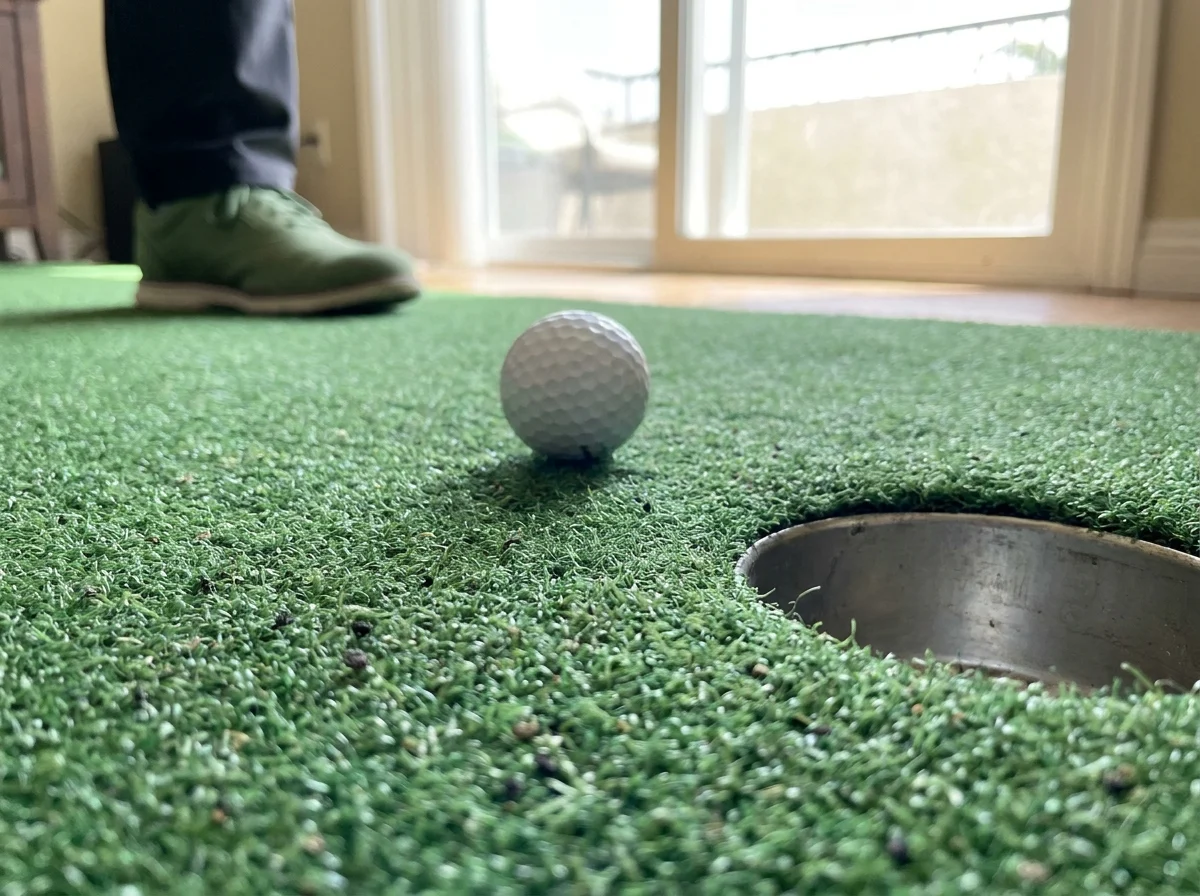
Cup placement is the part most people underestimate. A single cup straight ahead gets boring quickly. Two cups at different distances and angles forces you to change your aim line on every putt, which is how you actually build the muscle memory.
Standard cups are 4.25 inches in diameter, same as a regulation hole. Some people go with practice cups at 3.5 inches to train for a harder target. Either works.
Fringe turf (slightly higher pile around the perimeter of the green) adds to the look and gives you a visual boundary. It also lets you practice bump-and-run shots where you’re chipping onto the green from just off the edge. It adds $150 to $400 to the total cost depending on how much perimeter you’re fringing.
Installation day: what to expect
An indoor green in the 100 to 150 sq ft range takes most crews four to six hours. The sequence is straightforward:
- Clear the space and inspect the subfloor
- Lay underlayment, cut to fit
- Roll out and cut the turf
- Set cup locations, cut holes, install cups
- Stretch and glue or tack the perimeter
- Brush up the pile with a stiff broom
- Test roll and make adjustments
There’s no infill on most indoor putting greens. The nylon surface is firm enough on its own, and infill would slow the roll and change the feel. A few specialty high-speed surfaces use a small amount of sand infill to simulate faster greens, but that’s the exception.
For more on how artificial turf installation works across different applications, that page covers the broader process.
Common questions
Can I install an indoor putting green in a rental property?
Sometimes. If the green uses tack strips and no permanent adhesive, removal is straightforward and the slab stays undamaged. You’d need to confirm with your landlord first, but a non-glued installation in a garage is typically reversible. For second-floor rooms in a rental, the conversation gets more complicated because you’re modifying a wood subfloor.
How long does a nylon indoor putting green last?
A quality nylon surface sees 10 to 15 years of regular use before the pile starts to compress noticeably. If you’re rolling 50 to 100 putts a day in the same lines, you’ll see some wear track in those areas first. Rotating your cup positions every few months spreads the wear more evenly.
Does an indoor green need any maintenance?
Very little. Brush it with a stiff-bristle broom every week or two to keep the pile upright. Vacuum it occasionally if you’re in a garage with dust or debris. Wipe up spills with a damp cloth. There’s no watering, no mowing, no fertilizing.
What’s the fastest way to get a true roll on an indoor surface?
Pile height and base firmness. A 0.4-inch nylon pile on a concrete slab with a rigid underlayment gives you the fastest, truest roll. Thicker pile and softer bases introduce more unpredictable deviation. If you want to practice Stimpmeter 10 to 12 conditions, that’s the setup.
Ready to put one in?
The crews we send install indoor putting greens across all of San Diego County, from Oceanside and Vista down to Chula Vista and El Cajon, and everywhere in between. Contact us or call (858) 925-5546 for a free quote. We’ll measure your space, recommend the right surface for how you use it, and give you a flat price before we schedule anything.
You can also get a rough estimate with our turf cost calculator before we talk.