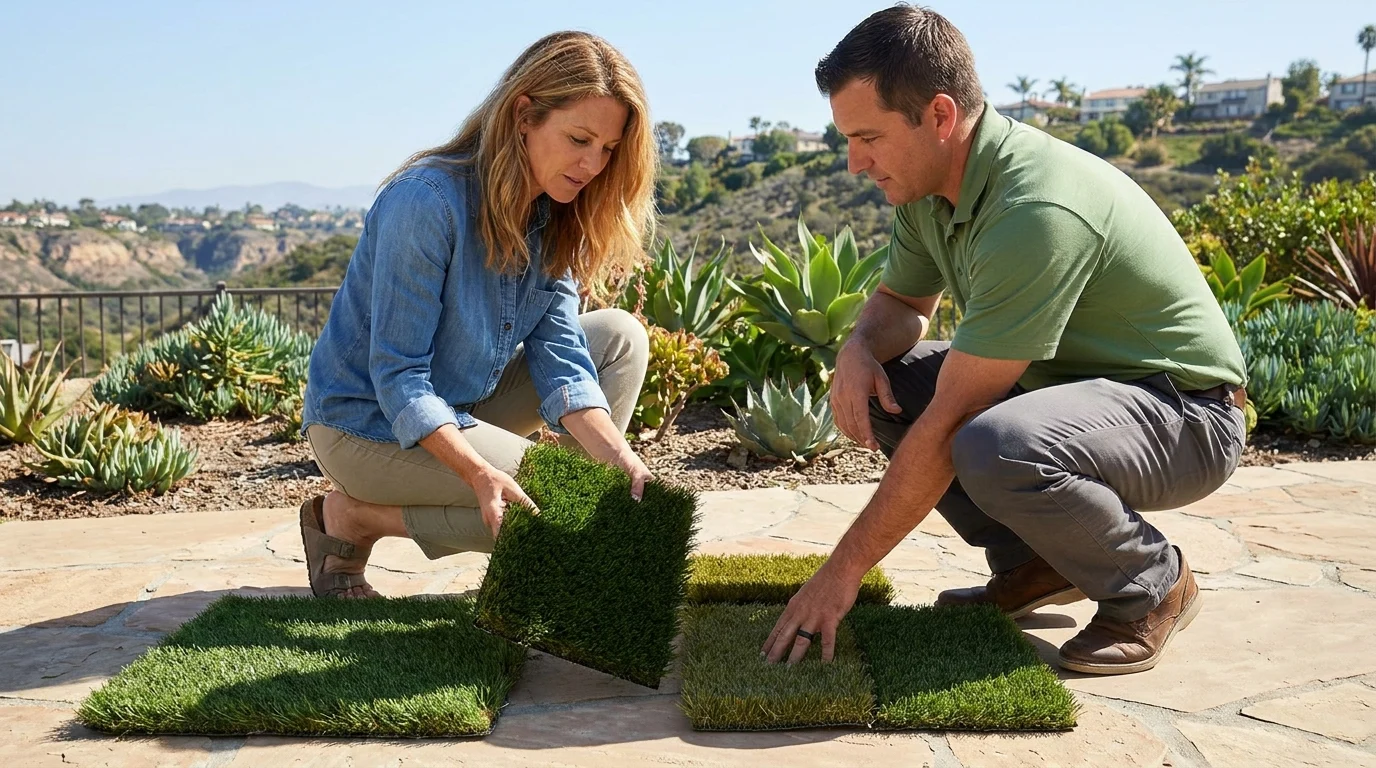
Match your turf to its job before you compare prices. A 1.75-inch, 70-oz lawn product looks great in a front yard but plays slow on a putting green and drains poorly under a dog run. Get the use case right first, then compare specs within that category.
The turf market is crowded with products that share a name but differ by 40 percent in quality. This guide walks you through every spec on the label, what it means for a San Diego yard, and the questions to ask before you sign anything.
Pile height: matching length to the job
Pile height is the length of the individual fibers, measured from the backing to the tip. It’s the most visible spec and, for most buyers, the most misunderstood.
Lawn turf: 1.25 to 2.25 inches
Most residential lawns in San Diego look best between 1.5 and 1.75 inches. That range is close enough to mowed grass that it reads naturally, but short enough that the blades stand upright rather than laying flat. Products past the 2-inch mark tend to mat down in high-traffic corridors, especially on slopes where foot traffic runs the same path every day.
Inland yards in Santee, El Cajon, or Escondido see ambient temperatures 10 to 20 degrees higher than coastal neighborhoods. Taller piles trap more heat. If your yard faces south or west and bakes in the afternoon, a shorter pile with a lighter color runs noticeably cooler underfoot.
Play areas and kids’ zones: 1.5 to 2.0 inches
Play areas benefit from a little extra cushion, so a 1.5 to 2.0-inch product with dense fiber spacing works well. If you’re adding backyard turf for kids, ask about products with shock-pad backing or plan to add an independent pad layer beneath. Neither pile height nor face weight alone guarantees adequate fall protection.
Putting greens: 0.375 to 0.75 inches
Putting green turf is a different product entirely. It’s short, firm nylon, cut tight, and the installation angle determines ball speed more than the turf itself does. For a residential putting green installation, pile height typically falls between 3/8 and 3/4 inch. Polyethylene blends in this range won’t hold a consistent roll.
Face weight and density
Face weight is the weight of the fibers per square yard, measured in ounces. It’s often cited as a quality shortcut, but it’s only useful alongside density and fiber shape.
What face weight tells you
A 50-oz product uses less fiber than an 80-oz product cut from the same pile height. More fiber means more durability, better blade recovery, and a fuller appearance over time. For residential lawns, most quality products fall between 50 and 90 oz. Below 50 oz, you’re usually looking at a commercial-rate product built for looks, not wear.
Higher face weight matters most in heavy-use corridors: the stretch of lawn between the back door and the gate, the strip next to the pool, the spot where the dog circles before lying down. In a low-traffic front yard, the difference between 60 oz and 80 oz is less meaningful.
Density fills in the gap
Two products can share the same face weight but have different stitch counts per row. A denser stitch count means the fibers sit closer together, which produces a fuller surface and better blade support. Look for stitch count or tuft count on the spec sheet alongside face weight. If a vendor only quotes one number, ask for both.
Fiber shape and type
The cross-section of each blade affects how it reflects light and how it behaves under foot traffic.
Polyethylene vs. nylon vs. polypropylene
Polyethylene is the standard for residential lawns and pet turf. It’s soft underfoot, UV-stable, and holds color well in San Diego’s sun. Most lawn products you’ll compare are polyethylene.
Nylon is stiffer and more heat-tolerant. It’s the right choice for putting greens and high-traffic applications where blade recovery matters more than softness. It costs more than polyethylene.
Polypropylene is the budget option. It goes flat faster, fades sooner, and doesn’t hold up well in direct sun. If a quote seems unusually low, confirm the fiber type before you move forward.
Blade shape: flat, W-shape, S-shape, diamond
Flat blades lie down easily and show compression. W-shape and S-shape blades are engineered to spring back after foot traffic. Diamond cross-sections scatter light at multiple angles, which reduces the sheen that makes cheap turf look obviously fake. For a front yard visible from the street, blade shape affects how natural the product looks more than color does.
Color and thatch: avoiding the fake bright green
The biggest tell on cheap turf is color. A single-tone neon green reads as obviously synthetic from 20 feet away.
Field color and secondary tones
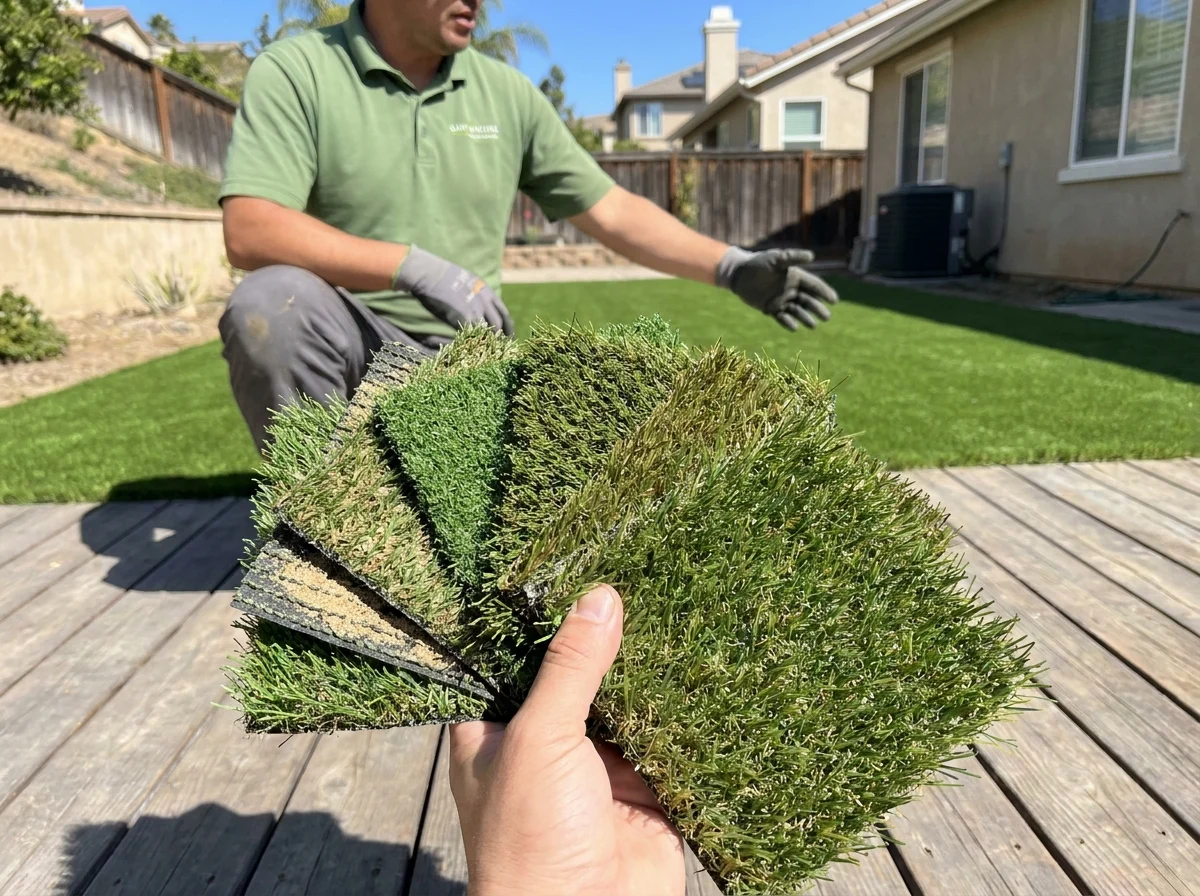
Quality products layer two or three shades: a primary field green, a slightly different secondary green, and often a tan or brown thatch. The variation mimics the tonal range of real grass. Request samples and put them next to natural grass in your yard, in full sun, before you decide.
Coastal San Diego neighborhoods in Encinitas, La Jolla, or Coronado tend to have cooler, more diffused light. Olive-toned greens look natural in that environment. Inland yards in Chula Vista or Lakeside see harder, more saturated light, where a slightly brighter mid-tone holds up better visually.
Thatch layer
The thatch is the shorter, curled fiber at the base of the pile. A good thatch layer fills in the visible backing, adds realism, and helps blades stay upright. Without it, the product looks flat. Brown thatch reads as the most natural. Green-only thatch is a sign of a lower-grade product.
Backing and drainage
The backing holds everything together and determines how well water moves through the product. In San Diego, drainage matters most for pet areas and low-slope yards.
Most quality products use a dual-layer polyurethane backing with a flow-through hole pattern. Look for a drainage rate above 30 inches per hour. For a pet turf installation, aim for products with 100-plus drainage holes per square foot, and confirm the base preparation includes a compacted decomposed granite or crushed rock layer that carries water to a drain or away from the foundation.
A single-layer backing with a low hole count will pool after heavy rain or repeated pet use. That’s a warranty issue waiting to happen.
Infill: matching it to the use
Infill is the material brushed into the turf after installation. It supports blade posture, adds weight, and in the case of pet areas, affects odor control.
Crumb rubber is the most common infill for general lawns. Silica sand is cooler and cleaner but needs more volume to support blade posture. Zeolite is a mineral infill used in pet applications for ammonia absorption. Coated sand blends balance temperature and blade support for high-traffic areas.
For more detail, see our guide to turf infill types.
Matching turf to specific uses
Pets
Pet urine concentrates ammonia in the infill layer. A 60-oz polyethylene product with a high-drainage backing, a zeolite or coated infill, and a compacted DG base clears odor far better than a denser product on a flat backing. Ask specifically about drainage rate and infill recommendations when you’re getting quotes for a dog run. More detail in the pet turf installation overview.
Kids’ play areas
Match a cushioned backing or pad layer to the fall height in the play zone. ASTM F1292 fall-height ratings are the standard reference. Soft polyethylene at 1.5 to 2.0 inches works well. Avoid nylon for barefoot play areas.
Putting greens
Nylon, short pile, firm backing, consistent grain direction. The installer’s technique and base prep determine pace more than the product itself. Ask to see completed residential greens before you commit to a contractor.
Shade vs. full sun
Full-sun products need better UV inhibitors and lighter base colors to stay cool. Shaded areas can handle darker, richer tones that would overheat in direct sun. If your yard is split between shade and full sun, talk to your installer about zoning the product rather than using one spec across the whole yard.
Warranty and what to ask the installer
Most quality products carry an 8 to 15-year manufacturer warranty covering UV fade and fiber integrity. That’s separate from any workmanship warranty the installer provides.
Questions to ask before you buy:
- What is the face weight, pile height, and fiber type for the specific product in this quote?
- What drainage rate does the backing carry, and what base preparation are you including?
- What infill type and depth do you recommend for this application, and why?
- What does the manufacturer warranty cover, and what voids it?
- What workmanship warranty do you provide, and what does it cover?
- Can I see two or three completed installations similar to mine?
A contractor who can answer those questions without hesitation is someone who knows what they’re selling. For a full breakdown of installation costs in San Diego, see artificial turf cost in San Diego 2026.
Common questions
What pile height is best for a San Diego backyard lawn?
For most residential lawns, 1.5 to 1.75 inches hits the right balance between appearance and durability. Inland yards that get full afternoon sun do better at the shorter end of that range to reduce heat retention.
Does a higher face weight always mean better quality?
Not on its own. Face weight and stitch density need to be read together. A 75-oz product with a low stitch count can perform worse than a 60-oz product with tight fiber spacing. Ask for both numbers.
How do I keep artificial turf from looking fake in a front yard?
Choose a product with two or three color tones and a brown thatch layer. Flat single-green products without thatch are the ones that read as obviously synthetic. Blade shape also matters: W-shape and diamond cross-sections scatter light more naturally than flat blades.
Is artificial turf suitable for a shaded yard near the coast?
Yes. Shaded areas in coastal neighborhoods like Pacific Beach or Carlsbad don’t see the heat buildup that inland yards do, so UV inhibitor ratings matter less. Focus on drainage, blade density, and color match. Get samples in your actual yard light before choosing.
Ready to spec the right product for your yard? Call us at (858) 925-5546 or visit our contact page to talk through your project. You can also explore artificial turf installation in San Diego or get a rough number with our turf cost calculator.